Why Your Disc Reads Differently Once the Leaves Start Turning
Quick Answer: Cooler, denser air makes every disc fly more overstable — it fades harder and finishes left earlier for a right-handed backhand. Combine that with a stiffer plastic in the cold and less grip from dry hands, and your fairway driver behaves like a disc a full stability step higher. Throw more understable discs, or accept 5 to 10 per cent less distance and adjust your lines.
You have thrown the same disc off the same tee three hundred times.
It has been finishing at the same spot all summer. Since about the middle of last week, it has been finishing thirty feet left of that and short.
Nothing about your form has degraded. The air changed.

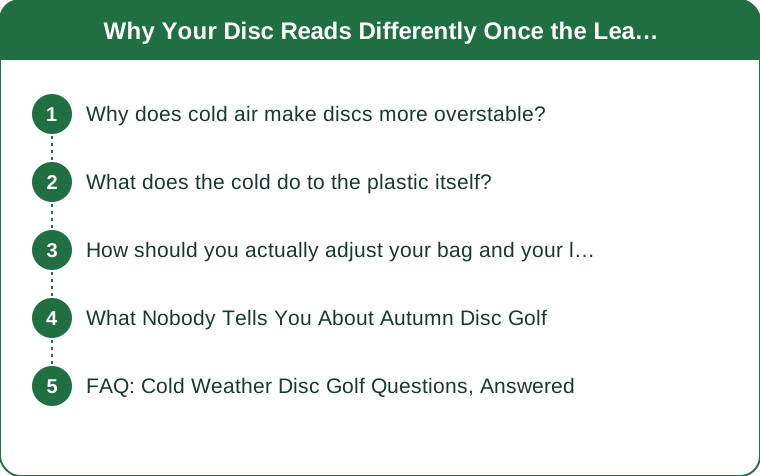
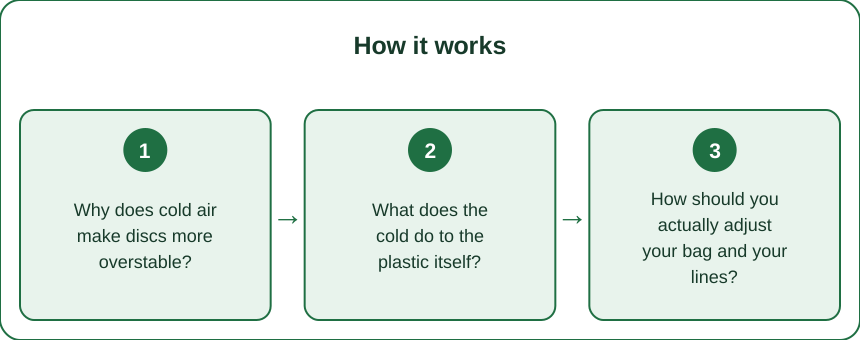
Why does cold air make discs more overstable?
It is air density, and the effect is larger than most players assume.
Cold air is denser than warm air — at the same pressure, air at 5°C is roughly 7 per cent denser than air at 25°C. A disc in flight is generating lift and experiencing drag, and both scale directly with air density.
Two consequences follow:
More aerodynamic force overall. More lift and more drag. Increased drag means the disc slows down faster, and a disc that slows down faster reaches the low-speed portion of its flight sooner — which is exactly the portion where fade dominates.
Stronger response to the disc’s stability characteristics. The turn-and-fade behaviour of a disc is a function of aerodynamic forces acting on an asymmetric spinning object. More force means more of whatever that disc naturally does, and for most drivers what it naturally does at the end of the flight is fade.
The practical result is that every disc in your bag behaves roughly one stability step more overstable in genuinely cold conditions than it did in summer. A neutral fairway driver becomes a mildly overstable one. A mildly overstable one becomes a hard-fading one.
There is a distance cost too. Increased drag means less carry — commonly 5 to 10 per cent less distance in cold conditions at the same arm speed. Combined with the earlier fade, a drive that was landing at 300 feet down a straight line might now be landing at 275 feet and forty feet to the left.
Neither of those is a form problem. Both are predictable and both can be planned for.
What does the cold do to the plastic itself?
A second, separate effect that compounds the first.
Disc golf plastics stiffen at low temperatures. The premium plastics that feel grippy and slightly flexible in summer become noticeably harder and more rigid, and the effect is most pronounced in the softer, grippier blends.
Three consequences:
Stiffer discs fly more overstable. A rigid disc holds its aerodynamic profile more precisely and flexes less on release. Flex, particularly in softer plastics, contributes to a slightly more understable flight — remove it and the disc firms up in every sense.
Discs are more likely to crack. This is the genuinely important one. Cold plastic is more brittle, and a hard tree hit that would have produced a scuff in July can produce a crack in November. Premium plastics are more resistant than base plastics but not immune.
Grip changes in both directions. Cold hands grip less securely, and cold plastic feels harder and slicker. Meanwhile the air is often drier, which reduces the natural moisture that helps grip. Grip loss on release causes early release and rollers, which look exactly like form problems.
Practical responses:
- Keep two or three discs in an inside pocket and rotate them, so your driver is warm when you throw it.
- Use a hand warmer in the bag, and put your throwing hand in a pocket between shots.
- Consider a slightly grippier plastic for cold months, accepting that it will be more affected by stiffening than a stable premium blend.
- Do not throw a cold disc at a tight tunnel line. If it is going to hit a tree, throw the one you would mind losing least.

How should you actually adjust your bag and your lines?
Two approaches, and most players end up doing some of both.
Approach one: shift the bag understable. Replace or supplement your usual discs with a step down in stability. If you throw a stable fairway driver off the tee, carry the understable version for cold rounds. Many players keep a small set of cold-weather discs specifically for this.
The advantage is that your usual lines still work. The disadvantage is that it requires owning more discs and rebuilding your feel for them.
Approach two: keep the bag and change the lines. Aim further right for a right-handed backhand, expect the fade to come earlier, and plan for less distance. Throw with slightly more hyzer-flip intention on lines that used to be flat.
The advantage is that you keep throwing discs you know. The disadvantage is that everything needs re-learning by feel, and re-learning by feel takes a round or two.
The hybrid most experienced players use: change the driver, keep the mids and putters. Distance drivers are where the stability shift costs you most, because they spend the longest in flight and lose the most to drag. Mids and putters are thrown at lower speeds over shorter distances and are less affected.
Adjust your putting too. A putt in cold, dense air drops slightly more and fades slightly more than the same putt in summer. Most players find they need marginally more power inside the circle, and the adjustment is usually made unconsciously after a few holes — but knowing it is coming stops the first few misses feeling like a form collapse.
What Nobody Tells You About Autumn Disc Golf
Things that only show up once you have played a few seasons through the change.
Leaves make discs disappear. This is the single largest practical change to autumn rounds. A disc that lands in leaf cover can be genuinely invisible from ten feet away, and a bright disc is dramatically easier to find than a dark one. This is the season to bag your loudest colours and to fit disc-finding aids if you play in heavy woods.
Sightlines change and then change again. Early autumn thins the canopy, which opens tunnel lines that were closed all summer — genuinely new shot options on courses you know well. Then the leaves come down and the ground changes instead.
Wet leaves are the most slippery surface on a course. Tee pads with leaf cover are a real fall risk on a run-up, and clearing the pad before you throw takes five seconds.
Skips stop working. A skip shot needs a firm surface. Damp ground and leaf cover kill skips almost entirely, so any line that relies on one needs rethinking from the tee.
Rounds take longer. Shorter days, more disc searching, more layers to manage. A round that took two hours in July can take two and a half, which matters when sunset is now considerably earlier than it was.
The wind is different, not just stronger. Autumn wind is often gustier and more variable in direction than the steadier summer breeze, and gusty conditions punish flat, high-glide lines far more than they punish low hyzers.
FAQ: Cold Weather Disc Golf Questions, Answered
At what temperature does this actually start to matter?
Most players start noticing around 10°C and find it clearly significant below about 5°C. The change from a warm late-summer round to a cool autumn one is smaller than the change from autumn to genuine winter, but it is enough to move a drive by twenty or thirty feet.
Should I buy a whole cold-weather bag?
Not necessarily. Adding one or two understable drivers to what you already carry covers most of the difference, and it is a cheaper and more flexible answer than a parallel bag. Full separate bags mostly make sense for players who compete year-round.
Does the disc weight matter more in the cold?
Slightly lighter discs are marginally easier to get out to distance when the air is dense and your arm speed is a little lower in the cold, so many players drop a few grams for winter. It is a real effect but a smaller one than the stability shift — fix stability first.
TL;DR:
- Cold air is around 7 per cent denser, which makes every disc fly roughly one stability step more overstable
- Expect 5 to 10 per cent less distance and an earlier, harder fade at the same arm speed
- Cold plastic stiffens, flies more overstable still, and cracks more easily on tree hits
- Either shift your drivers understable or re-aim and accept the new lines — most players change drivers and keep mids
- Bag bright discs for leaf cover, clear the tee pad, and stop relying on skips
Your form is fine. You are throwing the same disc into a measurably different atmosphere, and the discs that finished perfectly in August were tuned for air that is no longer there.
Keep Reading
This article is for general informational and styling purposes only. Fit, sizing, and product availability may vary.