How to Play Your First Round in Proper Wind
Quick Answer: Wind does not blow your disc off course so much as change how the disc behaves. A headwind makes a disc act more understable — it will turn over and fade less — while a tailwind makes it act more overstable and cuts your distance. The core adjustments are: throw more overstable discs into a headwind, more understable discs with a tailwind, keep the disc low and flat, and reduce power rather than adding it.
Your first genuinely windy round is a shock. Discs you have thrown a hundred times do things you have never seen them do. Drives you would normally trust end up in trees you did not know were in play.
The instinctive response — throw harder, aim further upwind — makes it worse.
Here is what is actually happening and what to do about it.

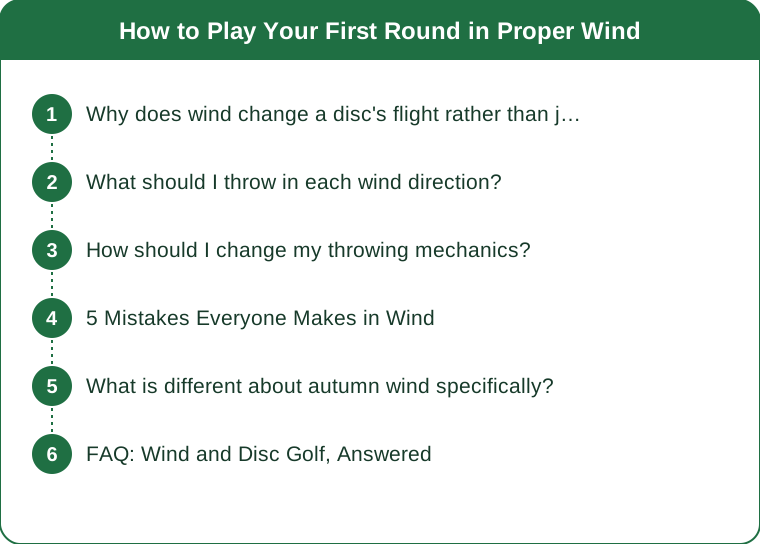
Why does wind change a disc’s flight rather than just moving it?
Because a disc is a wing, and its behaviour depends on the airspeed over it, not its speed over the ground.
A disc’s flight characteristics — how much it turns right early and fades left late, for a right-hand backhand throw — are determined by the relationship between its speed, its spin, and the aerodynamic forces acting on it. Those forces scale with airspeed.
Into a headwind, the air moving over the disc is faster than the disc’s ground speed. The disc behaves as though it were thrown harder than it was. A disc thrown harder turns over more — so a headwind makes every disc act more understable. Your reliable straight midrange will turn right and keep going. Your slightly understable driver will roll over completely.
With a tailwind, the airspeed over the disc is lower than its ground speed. The disc behaves as though thrown more gently — so it acts more overstable, fading earlier and harder, and it generates less lift, so it drops sooner and travels less far than you expect.
This is why a tailwind does not help you the way people assume. It reduces the aerodynamic force keeping the disc up.
Crosswinds act on whichever edge of the disc is presented to them, so the effect depends heavily on your release angle — which is why a flat release matters so much more in wind.
What should I throw in each wind direction?
Practical translations of the above.
Headwind. Go up in stability, down in speed. A slower, more overstable disc is far more predictable into wind than a fast distance driver, because the fast driver is being over-powered by the headwind. Release flat or slightly hyzer, keep the disc low, and throw with less power than usual. Trying to power through a headwind gives the disc more airspeed and more turn — the opposite of what you want.
Tailwind. Go down in stability. An understable disc will hold its line rather than fading, and the tailwind’s tendency to make things overstable is exactly compensated for. Release with a slight anhyzer or flat, and throw it higher than you would normally, because the reduced lift means it will drop early. Accept less distance than the tailwind seems to promise.
Left-to-right crosswind (for a right-hand backhand). The wind gets under the raised right edge of a hyzer release and lifts it, pushing the disc further right. Compensate by aiming left and using a more overstable disc.
Right-to-left crosswind. The wind pushes against the disc and tends to flip it. A more overstable disc and a flatter release helps.
The universal rule in any wind: lower is better. Wind speed increases with height above ground, sometimes substantially, and a disc kept under the treeline is in significantly less wind than one thrown high.
How should I change my throwing mechanics?
Less than you think, and in the opposite direction to your instinct.
Reduce power, increase spin. This is the key mechanical adjustment and it is counterintuitive. Spin stabilises a disc; raw speed destabilises it in a headwind. A smooth, snappy release with good wrist action and less arm speed produces a much more predictable flight than a maximum-effort throw.
Release flatter. Wind exploits any angle. A hyzer or anhyzer release presents an edge for the wind to act on, and small angle errors that are forgiving in calm conditions become large errors in wind.
Keep the nose down. Nose angle — whether the leading edge of the disc is pointed slightly up or down — matters enormously in a headwind. A nose-up release into wind will balloon, stall and drop short. This is the single most common cause of catastrophically short drives in headwinds.
Shorten your run-up. More consistency, less power, better angle control. Many experienced players go to a standstill throw in strong wind.
Widen your stance and slow down. You are being pushed on too, and balance errors translate directly into angle errors.
Do not aim dramatically upwind. Aim modestly upwind and choose a disc that resists the wind, rather than choosing a normal disc and aiming into the next fairway. Disc selection is a much more reliable correction than aim.

5 Mistakes Everyone Makes in Wind
Mistake one: throwing harder into a headwind. The most natural and most damaging response. More power means more airspeed means more turn. Throw smoother and more overstable instead.
Mistake two: throwing high with a tailwind. People assume a tailwind means free distance and launch it. In fact the reduced lift means the disc drops early, and you have handed it to the wind at the highest, windiest part of the flight.
Mistake three: not adjusting putting. Putting is where wind costs most strokes, and people focus entirely on drives. Into a headwind, putt firmer and flatter with more spin. With a tailwind, putt softer and lower — a floaty putt in a tailwind sails long every time.
Mistake four: ignoring gusts. A steady 20 kph wind is far easier than a gusty 15 kph one, because you can plan for steady wind. In gusty conditions, watch the treetops and wait for a lull before throwing. Waiting ten seconds is free.
Mistake five: using the same disc selection all round. Wind direction relative to you changes on every hole as the fairway orientation changes. A disc that was perfect on hole three may be exactly wrong on hole four. The second mistake here costs more distance than any other, precisely because it feels like the wind is helping.
What is different about autumn wind specifically?
Autumn is when most players meet real wind for the first time in a season, and there are a few specifics worth knowing.
Wind gets gustier. Autumn weather systems produce more variable, less steady wind than midsummer. Gusty conditions require patience more than technique.
Cold air is denser. Denser air produces more aerodynamic force at the same airspeed, which subtly increases both lift and turn. A disc thrown in 8°C behaves slightly more understable than the same disc in 28°C. Combined with a headwind, the effect compounds.
Plastic gets stiffer and grippier or slicker. Cold plastic is less flexible and the grip changes, particularly with softer plastics. Many players find they get less spin in the cold, which — as established above — is exactly the wrong direction for windy conditions. Keep a disc or two in a pocket to stay warm if you throw softer plastics.
Falling leaves change the fairway. Discs land in leaf cover and disappear. Watch your throws all the way down and mark landing points against a fixed reference, not just a general area.
Bare trees change the wind. As leaves drop, wooded fairways that were sheltered become far windier. A course you know well plays genuinely differently in November than in August, and this catches people out more than the temperature does.
FAQ: Wind and Disc Golf, Answered
How much wind is too much to play in?
There is no fixed limit and it is more about your comfort and safety than the score. Above roughly 40 kph, throwing accurately becomes largely a matter of luck, and falling branches become a genuine consideration in wooded courses. Below that it is playable and it is excellent practice.
Should beginners avoid windy days entirely?
No — but adjust the goal. Play for placement rather than distance, expect a worse score, and treat it as a lesson in disc behaviour. Windy rounds teach you what stability actually means faster than any amount of calm-weather throwing.
Does a heavier disc help in wind?
Generally yes. A heavier disc of the same mould has more momentum relative to the aerodynamic forces acting on it, so it is less affected. Carrying a couple of maximum-weight versions of your most reliable moulds is a common approach for windy conditions.
TL;DR:
- Wind changes how a disc behaves, not just where it goes — headwinds make discs act understable, tailwinds make them act overstable and cut distance.
- Into a headwind: more overstable, slower disc, flat and low release, less power and more spin. With a tailwind: more understable, thrown higher, expecting less distance.
- Reduce power rather than adding it, keep the nose down, shorten your run-up, and let disc selection do the correcting rather than your aim.
- Autumn brings gustier wind, denser cold air that increases turn, and bare trees that expose fairways which were sheltered all summer.
A windy round is the fastest education in disc stability available, which is worth remembering while it is going badly. Play one deliberately, pay attention to what each disc does rather than to your score, and calm days afterwards start to feel almost unfairly easy.
Keep Reading
This article is for general informational and styling purposes only. Fit, sizing, and product availability may vary.