Why Your Disc Golf Score Gets Worse on the Back Nine
Quick Answer: Back nine scores slip for four reasons, and only one is cardiovascular. Grip strength declines measurably over a round, throwing form loses timing before it loses power, decision quality drops as blood sugar and hydration fall, and course design frequently puts longer or more technical holes later. The high-value fixes are eating and drinking before you feel the need, shortening your throws on purpose after hole 12, and warming up so hole 1 is not your warm-up.
You were even par through nine. Then the wheels came off somewhere around 13 and you cannot point to a single bad throw that explains it.


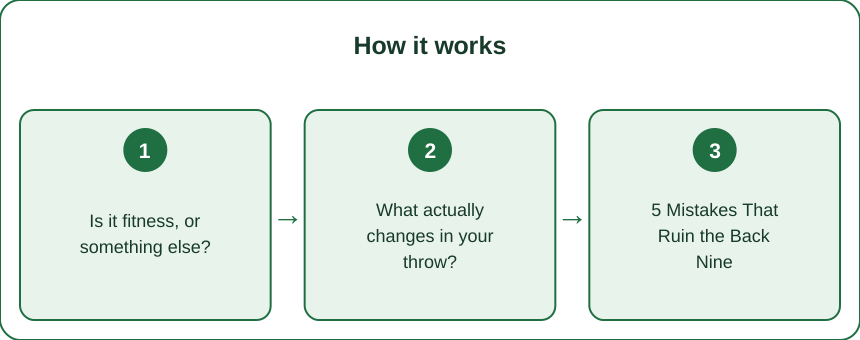
Is it fitness, or something else?
Mostly something else - which is why fitter players are surprised to find the pattern persists.
Grip strength is the underrated variable. Every drive requires a firm grip and a clean release, and grip fatigues quickly with repeated maximal effort. By hole 14 most players have measurably less grip force available, and a slightly early or late release changes flight path far more than a small loss of arm speed does.
Timing degrades before power does. A drive is a sequenced chain - legs, hips, torso, arm, wrist. Fatigue makes the sequence arrive slightly out of order, which produces exactly the failure players describe as the disc coming out flat or turning over unexpectedly. The arm still has the speed; the chain no longer fires in the right order.
Fuel and hydration decline quietly. A round is typically two to three hours of walking with intermittent maximal effort. Nobody feels dramatically depleted, but decision quality - club selection, line choice, risk assessment - degrades before physical capacity does.
Course design is often against you. Many courses deliberately place the longest and most technical holes in the back nine. Part of the score difference is simply that the second half is harder.
What actually changes in your throw?
The failure modes are consistent enough to self-diagnose.
Nose angle rises. Tired players unconsciously release with the nose up, which kills distance dramatically - often 30 to 50 feet - and produces a high, stalling flight. If your late-round drives are ballooning, this is why.
Rounding gets worse. As the core tires, the arm pulls across the body instead of staying in a straight line, which turns a controlled hyzer into an unpredictable one. Rounding is a strength-and-fatigue problem more than a technique problem in the back half.
Footwork shortens. The X-step compresses when legs tire, reducing the weight transfer that generates most of your distance. Players then compensate by muscling with the arm, which makes the timing worse.
Putting stroke shortens and speeds up. This is where the strokes actually accumulate. Late-round putting misses are usually short and firm - a stroke that has lost its follow-through. More back nine strokes are lost inside 30 feet than off the tee, which is worth knowing before you blame your drives.

5 Mistakes That Ruin the Back Nine
Mistake 1: Not warming up, and using holes 1 to 3 for it. Cold throwing is both a scoring problem and an injury one. Ten minutes of easy throws and some rotational movement before you start protects the front nine and leaves more in the tank for the back.
Mistake 2: Waiting until you are thirsty to drink. Thirst arrives after the performance cost. In warm late-summer weather, aim for roughly 16 to 20 ounces per hour of walking, starting from the first hole rather than the tenth.
Mistake 3: Eating nothing until you feel hungry. A small snack around hole 6 or 7 - before you need it - keeps decision quality steady for the back nine. Waiting until hole 14 means eating after the damage.
Mistake 4: Throwing maximum distance on every drive. Grip and timing fatigue is driven by maximal efforts. Throwing at about 80 percent costs you very little distance because the timing improves, and it preserves the grip you will need later.
Mistake 5: Chasing the score. Once a couple of strokes go, players reach for lines they would never take on hole 3. The back nine collapse is usually two fatigue strokes followed by three decision strokes, and the decisions are the bigger half.
What should you change after hole 12?
Treat the last six holes as a different round with different rules.
Shorten deliberately. Take one disc less than instinct suggests and throw a controlled, clean line. Late-round distance is unreliable; late-round accuracy is achievable. A confident 280 beats an attempted 340 that fades unpredictably.
Slow the pre-throw routine. Fatigue speeds people up - shorter setup, faster pull, quicker putt. Adding five deliberate seconds before each throw is close to free and reverses the main mechanism.
Reset the grip consciously. Grip pressure drifts as the hand tires. Re-set your grip and check pressure before each drive rather than assuming it is where it was on hole 4.
Recommit to full follow-through on putts. Since the late-round miss is short and firm, deliberately finishing the stroke solves most of it. Pick one cue - finish with the hand pointing at the chains - and hold it for six holes.
Accept the course. If the back nine at your course is genuinely longer, your score there should be higher, and comparing halves is not a fair measure of your play. Track back nine against your own back nine history instead - it is the only comparison that means anything.
FAQ: Back Nine Disc Golf Questions, Answered
Should I carry fewer discs to reduce fatigue?
Bag weight contributes over 18 holes, particularly on hilly courses, but the bigger factor is throwing effort rather than carrying. Trimming a bag from 20 discs to 12 is worth doing for other reasons and will not by itself fix a back nine slide.
Does grip strength training help?
Modestly, yes - it delays the onset of grip fatigue. Simple work like farmer carries or hangs a couple of times a week is enough. It will not fix a timing problem, which is a technique-under-fatigue issue.
Why is it worse in hot weather?
Heat accelerates both dehydration and grip degradation, since sweaty hands change release consistency. In late-summer heat, a towel and a chalk bag are legitimate scoring equipment rather than accessories.
Is a shorter round a better practice option?
Often yes. If your goal is technique, nine focused holes produce better throws than 18 tired ones. Save full rounds for when you want the endurance element specifically.
This is general information, not medical advice.
TL;DR:
- Back nine decline is mostly grip fatigue, timing degradation, and declining decision quality - not cardiovascular fitness.
- The visible failures are nose-up drives, rounding, a shortened X-step, and short firm putts.
- Eat and drink before you need to, warm up so hole 1 is not your warm-up, and throw at about 80 percent all round.
- After hole 12, take one disc less, add five seconds to your routine, and commit to full follow-through on putts.
The most useful reframe is that the back nine is not a test of endurance - it is a test of whether you set yourself up during the front nine. Almost everything that determines your last six holes was decided before hole 10, which means it is a planning problem rather than a fitness one.
Keep Reading
This article is for general informational and styling purposes only. Fit, sizing, and product availability may vary.