Why Your Disc Always Curves the Same Direction — It's Not Your Throw
Quick Answer: If your disc curves the same direction every time regardless of how you throw it, check the flight numbers stamped on it — a high-turn, low-fade disc will hook that way at almost any speed you can generate, and no amount of form correction changes that.
You’ve worked on your grip, your reachback, your follow-through, and the disc still banks hard right (or left) every single time. Before you blame your mechanics for the tenth round in a row, flip the disc over and read the four numbers stamped on it — they’re probably the actual answer.

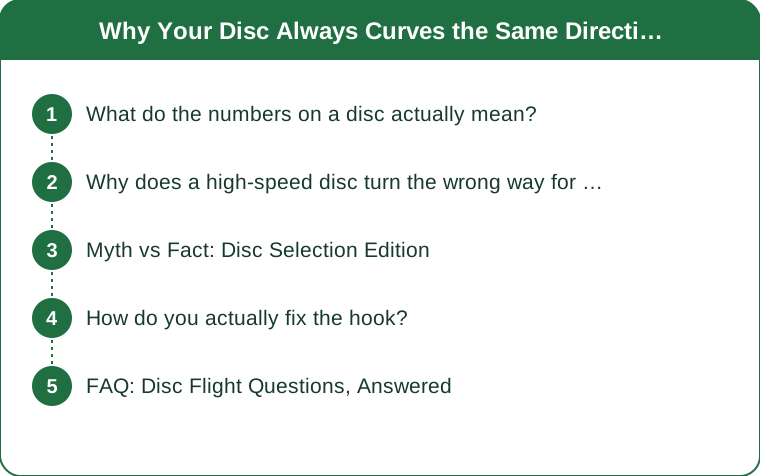
What do the numbers on a disc actually mean?
Every disc has 4 numbers: Speed, Glide, Turn, Fade — in that order.
Speed (1-14) is how fast you need to throw it to fly as designed. Glide (1-7) is how long it stays airborne. Turn (+1 to -5) is how much it curves during flight, and Fade (0-5) is how hard it hooks back at the end.
A disc with Turn of -4 and Fade of 1 will bank hard one direction almost regardless of your form — that’s not a swing flaw, that’s the disc doing exactly what it’s stamped to do.
Why does a high-speed disc turn the wrong way for beginners?
Because turn only shows up if you can generate enough speed to trigger it. A speed-11 driver thrown at beginner arm speed doesn’t turn at all — it just falls out of the sky and fades hard, which reads as ‘it always hooks left’ when the real issue is the disc never reached flying speed to begin with.
This is the mismatch that frustrates more new players than any grip issue: the disc on the shelf marked ‘distance driver’ needs more arm speed than most beginners have yet.

Myth vs Fact: Disc Selection Edition
Myth: More expensive plastic flies straighter. Fact: Plastic type affects durability and grip, not flight path. A $20 premium driver has the identical flight numbers as the $12 base-plastic version of the same mold.
Myth: A ‘stable’ disc means it flies straight. Fact: Stable just means turn and fade roughly cancel out at your specific arm speed. The same disc can look understable in a strong arm and overstable in a weaker one.
Myth: You need a full bag of 15+ discs to improve. Fact: Most improvement in year one comes from learning 3-4 discs intimately, not owning more plastic.
How do you actually fix the hook?
Two options, and only one requires new plastic:
- Match the disc to your current arm speed. Drop down to a speed 6-8 midrange or fairway driver — lower speed numbers need less power to fly correctly, so the flight path stops fighting your throw.
- Build arm speed deliberately with a reachback and hip-rotation drill before adding more speed-rated discs to the bag.
Most players who ‘always hook one way’ fix it by dropping 2-3 speed numbers, not by rebuilding their form from scratch.
FAQ: Disc Flight Questions, Answered
What’s the best beginner disc for going straight?
Look for low turn (0 to -1) and low-to-moderate fade (1-2) at speed 5-7. These fly the most predictably at beginner arm speeds.
Why does my disc fly great for my friend but hook for me?
Arm speed. The same disc reads completely differently depending on how fast it’s released — it’s not a flaw in the disc or in your form, just a mismatch between the two.
Should I sand or beat in a disc to change its flight?
Overuse naturally makes discs more understable over time (more turn, less fade). It works, but slowly — buying the right flight number up front is faster than waiting for plastic to wear in.
TL;DR:
- A disc curving the same way every throw is often the flight numbers, not your form
- Turn only activates at sufficient arm speed — beginners often can’t trigger it yet
- Plastic price affects durability, not flight path
- Drop 2-3 speed numbers before assuming your technique is broken
Read the disc before you rebuild your swing — the fix is often already in your bag.
Keep Reading
This article is for general informational and styling purposes only. Fit, sizing, and product availability may vary.