How to Read Wind on a Disc Golf Course Instead of Guessing
Quick Answer: Wind changes disc behaviour predictably. A headwind makes every disc more understable - it will turn and fade less than usual, so throw a more overstable disc than you normally would. A tailwind makes discs more overstable and reduces lift, so throw more understable and expect less distance. Crosswind pushes the disc laterally and also affects stability depending on which side of the disc the wind hits.
Everybody knows wind matters. Fewer people can say which direction it will push a specific disc.
The rules are consistent, and once you know them you can pick a disc rather than hope.

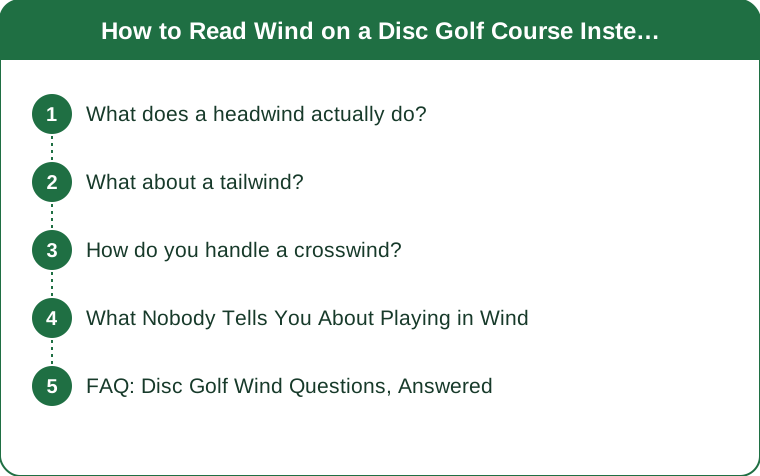
What does a headwind actually do?
It makes every disc behave as if it were more understable, and it is the most counterintuitive of the three.
The mechanism is relative airspeed. A disc’s flight characteristics depend on how fast air moves over it, not on ground speed. A headwind increases the airspeed over the disc beyond what your arm produced - so the disc behaves as though thrown considerably harder.
And a disc thrown harder turns more. High-speed turn is what happens when a disc is thrown above its intended speed - it banks to the right for a right-handed backhand throw. A headwind produces this effect without you throwing harder.
What this looks like in practice: your reliable straight fairway driver turns over and cuts hard right, finishing far off target. The disc did not fail; the air did something to it.
The fix: throw more overstable than usual. A disc that would normally fade too much for the line becomes the correct choice in a headwind, because the wind cancels part of that fade.
Additional headwind adjustments:
- Throw with less nose angle - a nose-up throw in a headwind climbs, stalls, and drops short. This is the biggest distance killer
- Lower the release point to keep the disc out of the strongest wind
- Expect less distance, and accept it rather than throwing harder
The most common headwind mistake is throwing harder. More power means more airspeed means more turn - it makes the exact problem you are experiencing worse. Smooth and flat beats hard every time into wind.
What about a tailwind?
The opposite effect, plus a distance problem people do not expect.
A tailwind reduces relative airspeed, so the disc behaves as though thrown more slowly - which means more overstable. Your straight disc fades early and hard left; your understable disc flies straight.
The fix: throw more understable than usual. A tailwind is when the disc that normally turns over too much becomes correct.
The distance surprise: many players assume a tailwind adds distance. It usually reduces it. Reduced airspeed means reduced lift, so the disc drops out of the air earlier despite being pushed along the ground track.
How to compensate:
- Throw with a slight nose-up angle - the opposite of headwind technique - to generate lift the wind is not providing
- Release higher, giving the disc more time before it descends
- Expect it to skip more on landing, because it arrives at a shallower angle with forward momentum
The skip point matters more in a tailwind than anywhere else. A disc that would stop reliably lands flatter and runs, which is how tailwind approach shots end up 15 metres past the basket.
On putting in a tailwind: the disc will carry further than expected and is less stable in the air. Most players compensate by putting with more spin and less power, which keeps it stable without adding carry.

How do you handle a crosswind?
Two effects at once - lateral push and a stability change - and the second is the one people miss.
The lateral push is straightforward. The wind moves the disc downwind throughout its flight, so you aim upwind to compensate. The correction needed scales with wind strength and flight time - a long drive spends more time in the air and needs more.
The stability effect is where it gets interesting. A crosswind hitting the disc from one side interacts with the disc’s rotation and lift, and the direction of the effect depends on which edge the wind meets.
For a right-handed backhand throw:
- Wind from the left tends to make the disc behave more understable - lifting the left edge and encouraging turn
- Wind from the right tends to make it behave more overstable - pushing the disc to fade harder and earlier
Which produces a useful combination: wind from the right pushes the disc left and also makes it fade harder left. Both effects stack, and it is easy to under-correct dramatically.
Wind from the left is more forgiving in one sense - the push is leftward while the added turn is rightward, so the effects partly counteract. It is also less predictable, because the balance between them depends on the disc and the throw.
Practical crosswind approach:
- Use a more overstable disc in a left-to-right wind and let it fight the turn
- Aim well upwind and trust it - the most common error is under-aiming
- Consider throwing lower where the wind is weaker near the ground and among trees
- Forehand throws reverse these relationships, because the disc spins the other way
What Nobody Tells You About Playing in Wind
Five things that separate people who cope with wind from people who fight it.
Nose angle matters more than disc selection in wind. A nose-up release into a headwind stalls and drops regardless of which disc you chose. Getting the nose down is worth more than any disc in the bag - and it is a technique fix, so it works everywhere.
Wind at ground level is not wind at 10 metres. Trees, terrain and buildings mean the wind you feel standing on the tee can be substantially different from what the disc encounters. Look at the treetops rather than at the grass.
Low throws are the reliable wind strategy. Wind speed increases with height above ground - this is basic boundary layer behaviour. A flat, low throw spends its flight in slower air. It is not glamorous and it is consistently effective.
Overstable discs are what wind experience looks like in a bag. Players who play in wind regularly carry more overstable options than players who do not. If you consistently play windy courses, the bag should reflect it rather than being rebuilt from calm-day preferences.
Wind punishes power and rewards control. The instinct in wind is to throw harder. Almost every wind adjustment points the other way - smoother, flatter, lower, and accepting less distance. The players who do well in wind are the ones who stopped trying to overpower it.
FAQ: Disc Golf Wind Questions, Answered
Why does my disc turn over in a headwind when I threw it the same as always?
A headwind increases the airspeed over the disc, so it behaves as if thrown much harder - and harder throws turn. Nothing changed about your throw; the air added speed. Switch to a more overstable disc.
Should I throw harder into a headwind?
No - it is the most common mistake. More power increases airspeed further and makes the turn worse. Smooth, flat and nose-down produces more distance into wind than a hard throw.
Does a tailwind give me extra distance?
Usually less, not more. Reduced airspeed means reduced lift, so the disc descends earlier even though it is being pushed along. A slight nose-up angle and a higher release help recover some of it.
How much should I aim into a crosswind?
More than feels right - under-aiming is the standard error. The correction scales with wind strength and time in the air, so a long drive needs considerably more than an approach shot.
Do these rules reverse for forehand throws?
The crosswind stability relationships reverse, because the disc spins the other way. Headwind and tailwind effects on stability work the same regardless of throwing style.
What should I add to my bag for windy courses?
An overstable fairway driver and an overstable midrange cover most situations. They are the discs that stay predictable when the wind is making everything else behave differently.
TL;DR:
- Headwind increases airspeed, so discs behave more understable - throw more overstable and keep the nose down
- Never throw harder into a headwind; it makes the turn worse
- Tailwind makes discs more overstable and reduces lift, so throw understable and expect less distance and more skip
- Crosswind pushes laterally and changes stability - right-to-left wind stacks both effects and needs more correction than feels right
- Wind speed increases with height, so low flat throws stay in slower air
- Nose angle beats disc selection; wind rewards control over power
The wind is doing something specific and predictable. Pick the disc for it instead of hoping.
Keep Reading
This article is for general informational and styling purposes only. Fit, sizing, and product availability may vary.