3 Disc Golf Throwing Form Fixes That Add Real Distance Without More Power
Quick Answer: The biggest distance gains in disc golf typically come from improving hip rotation sequencing, follow-through extension, and disc angle at release rather than throwing harder — these three form corrections often add more distance than months of general arm-strength training.
A lot of players trying to add distance focus on throwing harder, when the actual limiting factor is usually technique, not power.

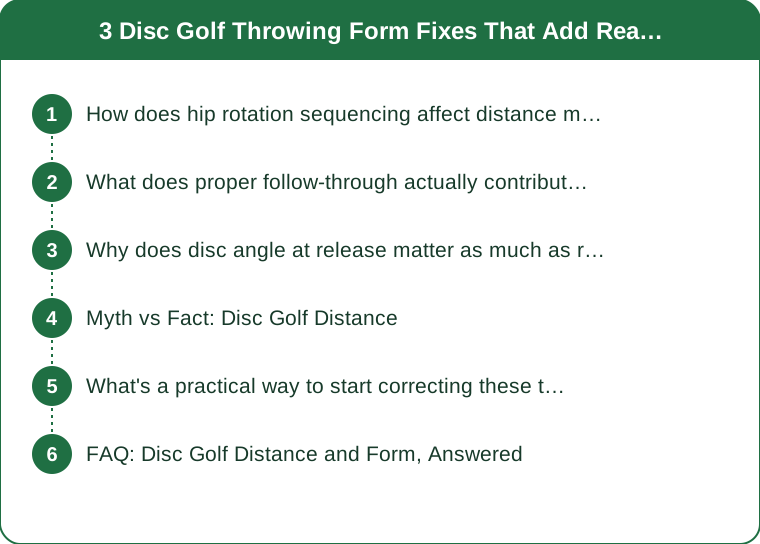
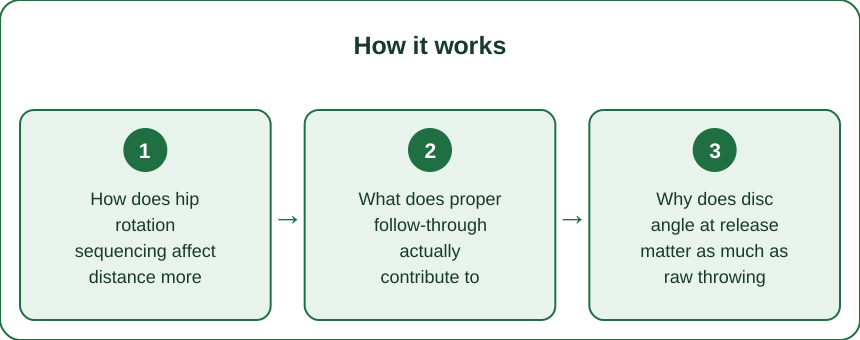
How does hip rotation sequencing affect distance more than arm speed?
Distance in disc golf comes primarily from generating power through a sequenced kinetic chain — hips rotating before the shoulders, which rotate before the arm — rather than arm speed alone. Players who lead with their arm rather than letting hip rotation initiate the throw lose a significant amount of potential power transfer, regardless of how hard they swing their arm.
What does proper follow-through actually contribute to distance?
A full follow-through, where the throwing arm continues extending across the body after release rather than stopping abruptly, indicates the disc received the full available power through release rather than being cut short. A truncated follow-through is often a sign that deceleration started before release, which directly reduces disc speed at the moment that matters most.
Why does disc angle at release matter as much as raw throwing power?
A disc released with too much anhyzer (tilted away) or hyzer (tilted toward) angle loses distance to unwanted curve rather than traveling in an efficient flight path, meaning two throws with identical power can travel very different distances purely based on release angle. Dialing in a flatter, more neutral release angle for distance-focused throws often adds more real-world distance than increasing power.

Myth vs Fact: Disc Golf Distance
Myth: More arm strength is the primary way to add throwing distance. Fact: Kinetic chain sequencing and release mechanics typically contribute more to distance than raw arm strength for most players.
Myth: A more powerful disc (higher speed rating) automatically means more distance. Fact: High-speed discs require strong throwing technique to fly properly — with weaker form, a lower-speed disc thrown well often travels farther.
What’s a practical way to start correcting these three issues?
Practicing slow-motion or reduced-power throws focused purely on hip-lead sequencing and full follow-through, without trying to maximize distance in the same rep, helps isolate and correct form issues that get masked when throwing at full effort. Once the sequencing feels natural at lower effort, it transfers to full-power throws more reliably.
FAQ: Disc Golf Distance and Form, Answered
How much distance can proper form realistically add compared to raw power training?
Many players report significant distance gains purely from form correction, often more than they’d gain from months of general strength training alone.
Should beginners focus on distance or accuracy first?
Accuracy and consistent form generally should come first — distance built on inconsistent form doesn’t translate to lower scores as effectively.
Does disc weight affect how much these form corrections matter?
Lighter discs are somewhat more forgiving of form errors, so form corrections tend to show the most dramatic distance improvement with standard or heavier discs.
TL;DR:
- Hip rotation sequencing before arm movement is a bigger distance factor than arm strength
- A full follow-through indicates power was transferred through release, not cut short
- Release angle affects distance as much as raw power by controlling unwanted curve
- Practicing form at reduced power helps isolate and fix these issues before adding power back
Next time you’re on the course, try a few reduced-power throws focused purely on hip lead and follow-through — the distance gain from cleaner form often surprises people.
Keep Reading
This article is for general informational and styling purposes only. Fit, sizing, and product availability may vary.