Why Your Disc Golf Throw Falls Apart Late in the Round — and How to Stop It
Quick Answer: Late-round accuracy drops are usually caused by fatigue in the core and shoulder stabilizers, which subtly shortens your reach-back and rushes the follow-through — not a sudden loss of skill. Slowing the tempo down and shortening your target distance expectations late in the round compensates for it.
Holes 1 through 8 look like your best form. By hole 14, drives that used to land center-fairway are drifting wide, and it feels like the skill just evaporated. It didn’t — the mechanics quietly shifted under fatigue.

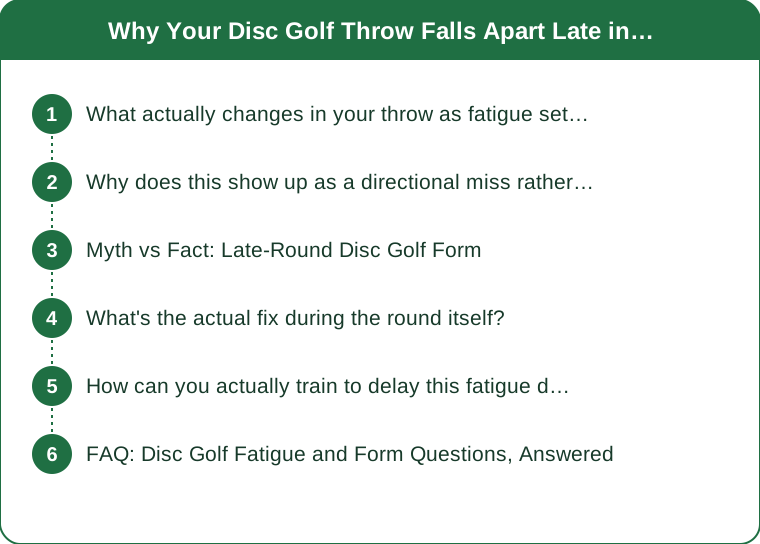
What actually changes in your throw as fatigue sets in?
Core and shoulder stabilizer fatigue reduces how far back you can comfortably reach and how controlled your follow-through stays, which shortens your effective power window and throws off timing that was consistent earlier in the round.
Why does this show up as a directional miss rather than just less distance?
A fatigued core often can’t stabilize rotation as precisely, so the disc release point shifts slightly off from where it was on hole 1 — and because disc golf flight is extremely sensitive to release angle, even a small shift reads as a big directional miss downrange.
Myth vs Fact: Late-Round Disc Golf Form
Myth: A late-round miss means you lost focus mentally. Fact: It’s more often physical — stabilizer fatigue changing your mechanics — even when focus and effort feel unchanged.
Myth: Pushing harder on tired throws will compensate for the form breakdown. Fact: Pushing harder on a fatigued, less-stable base usually makes the miss worse, not better.
Myth: Elite players don’t experience this fatigue drift. Fact: Even experienced players see mechanical drift late in long rounds — the difference is they adjust for it rather than fighting it.

What’s the actual fix during the round itself?
Slow the tempo down on later holes rather than trying to match your early-round pace and power — a smoother, less rushed release compensates for reduced stabilizer control better than forcing full power through fatigue.
Also worth lowering distance expectations slightly late in the round and clubbing down (choosing a more controllable disc) rather than fighting for max distance on a tired body.
How can you actually train to delay this fatigue drift?
Core and rotational stability work off the course — planks with rotation, cable woodchops — builds the specific stabilizer endurance that disc golf throws rely on late into a long round, which is different from general cardio conditioning.
Practicing throws deliberately at the end of a workout, when already somewhat fatigued, also trains your body to maintain form under the exact condition a late-round hole presents.
FAQ: Disc Golf Fatigue and Form Questions, Answered
Why does my drive drift off-line specifically in the back nine?
Stabilizer fatigue in the core and shoulders shifts your release point slightly, and because flight path is very sensitive to release angle, a small shift becomes a large directional miss.
Should I use a different disc late in the round?
Switching to a more forgiving, controllable disc late in the round can offset reduced precision better than forcing your usual max-distance disc through fatigue.
Can training fix late-round form breakdown?
Yes — rotational core stability training specifically targets the stabilizer endurance that fatigues late in long rounds, more directly than general cardio conditioning does.
TL;DR:
- Late-round misses are usually stabilizer fatigue shifting your release point, not a mental lapse
- Small release-angle shifts produce large directional misses because flight is release-sensitive
- Slowing tempo and clubbing down late in the round compensates better than forcing full power
- Core rotational stability training off the course delays this fatigue drift over time
The form isn’t disappearing late in the round — it’s shifting under fatigue, and the fix is adjusting for that shift, not fighting it.
Keep Reading
This article is for general informational and styling purposes only. Fit, sizing, and product availability may vary.