Disc Golf Shoes: Why Footing Costs You More Distance Than Your Form Does
Quick Answer: Disc golf distance comes from the ground up, and a plant foot that slips even slightly bleeds power out of the throw before it reaches your arm. Most people play in running shoes or casual sneakers, both of which have smooth or forward-biased outsoles that slip on the lateral plant. Trail runners with multidirectional lugs are the cheapest meaningful upgrade to your drive.
Everybody wants more distance. Everybody films their form. Almost nobody looks down.
The plant foot in a disc golf drive absorbs the entire momentum of the run-up and converts it into rotation. If that foot slides two centimetres at the moment of the plant, the energy you built up over three strides does not get transferred — it gets absorbed by the ground.

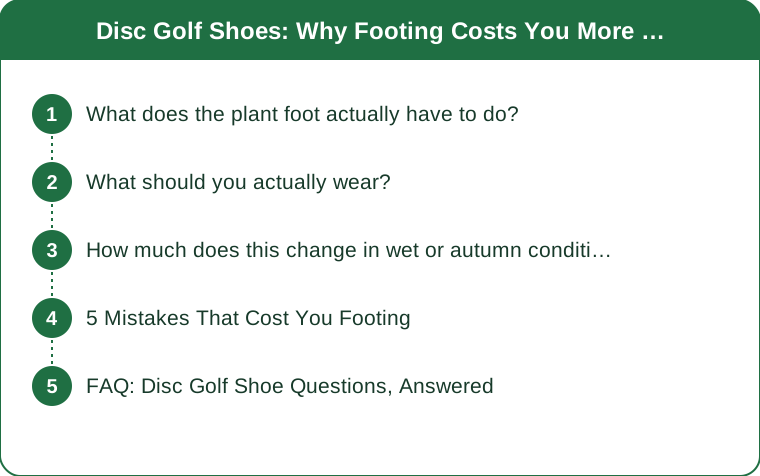
What does the plant foot actually have to do?
It has to stop you, hold you, and let you rotate around it — three demands that pull in different directions.
In a standard backhand drive, the run-up builds forward momentum. The plant foot lands at an angle, roughly perpendicular to the target line, and has to arrest that forward momentum almost instantly. The force involved is substantial — comparable to a hard change of direction in tennis or basketball.
Then, immediately, the body rotates around that fixed point. So the shoe needs to grip firmly against lateral and rotational shear, in a direction that has nothing to do with forward running.
This is exactly the loading pattern that road running shoes are not designed for. Running shoe outsoles are optimised for forward propulsion and heel-to-toe roll, with soft flexible midsoles that compress unevenly under lateral load. A running shoe on a damp grass teepad under a hard plant is close to a worst case.
The symptom, when it happens, does not feel like slipping. It feels like the throw came out flat, or lost power for no reason, or that your timing was off. Most people diagnose it as a form issue because the slip is small enough that you never consciously notice it.
What should you actually wear?
Three tiers, and the middle one covers most players.
Trail running shoes. The practical default and the best value. Multidirectional lugs of 3 to 5mm grip grass, dirt and leaf litter in every direction, and the firmer midsole holds up under lateral load. A decent pair runs $90 to $140 and doubles for hiking. If you buy one thing from this article, buy these.
Approach or hiking shoes. Stiffer, more protective, better on rocky or root-heavy courses. Heavier and less comfortable for a full round of walking, but the stability is excellent for the plant.
Dedicated disc golf shoes. These exist now, built with reinforced medial sides for the plant foot and grippy outsoles. Genuinely good if you play weekly. Overkill if you play monthly.
What to avoid: road running shoes (smooth outsole, soft midsole), skate shoes and casual sneakers (flat outsole with almost no grip on grass), and anything with a worn tread. Boots are stable but too heavy and stiff for a comfortable run-up.
One detail worth checking: the medial (inside) upper of the plant shoe takes a lot of abrasion, because the foot rolls onto its inside edge during rotation. Cheap shoes blow out there first. If your last pair failed on the inside of the left shoe (for a right-handed backhand), that is why, and it is a sign the shoe was too soft.

How much does this change in wet or autumn conditions?
Enormously, and this is the season it starts to matter.
Wet grass reduces available friction dramatically, and the effect is not linear — a lightly damp teepad is manageable, and a saturated one is close to unplayable in the wrong shoes. Morning dew alone, which is heavier now as nights cool and humidity condenses, is enough to change footing on an 8am round.
Fallen leaves are the underrated hazard of September and October. A layer of dry leaves on grass slides as a sheet, and a layer of wet leaves is effectively ice. This catches people out because the ground underneath feels solid.
Mud clogs lugs, which turns a grippy trail shoe into a smooth one. Deep, widely-spaced lugs shed mud; shallow closely-spaced lugs pack solid. If you play in genuinely wet conditions, lug spacing matters more than lug depth.
Concrete and rubber teepads when wet are their own problem — smooth concrete with a film of water is slippery in any shoe, and this is where a sticky rubber outsole outperforms an aggressive lug, since lugs need something to bite into.
The practical adjustment for autumn: shorten your run-up. A two-step approach loses a little distance and loses far less than a slipped plant does. Most experienced players do this instinctively once conditions turn; newer players keep the full run-up and wonder why their scores drift upward from October.
5 Mistakes That Cost You Footing
1. Playing in worn shoes. Lugs round off gradually and you adapt without noticing. Look at the tread on the outside edge of your plant shoe — if the lugs there are visibly rounder than the ones in the middle, the shoe is done for disc golf even if it is fine for walking.
2. Ignoring the teepad surface. Concrete, rubber, gravel, dirt and grass all behave differently, and a shoe that grips beautifully on grass can be poor on wet concrete. If your course has mixed teepads, favour a shoe with a mix of lugs and flatter contact patches.
3. Running up too fast for the conditions. More speed means more momentum to arrest, which means more force at the plant. On marginal footing this is the first thing to reduce.
4. Planting on the heel. A heel-first plant concentrates all the force on a small contact patch and is far more likely to slip than a flatter mid-foot plant. This is technique rather than gear, but it interacts directly with it.
5. Wearing the same shoes for the round and the drive there. This one sounds fussy and is not. Shoes worn on pavement, in shops and around the house pick up polish on the lug edges and wear down faster. A pair kept in the car for rounds lasts significantly longer and grips better.
FAQ: Disc Golf Shoe Questions, Answered
Are cleats or spikes allowed?
Most courses permit them and most players find them unnecessary and unpleasant to walk in for a full round. Soccer or lacrosse cleats give tremendous plant grip on grass and are genuinely uncomfortable over five kilometres of mixed terrain. Some players keep a cleated pair for tournament rounds on wet grass.
How long do disc golf shoes last?
Roughly 150 to 250 rounds for a trail shoe, depending on terrain. The failure point is usually the medial upper or the outside lugs rather than the midsole, which is different from running shoes.
Do I need waterproof shoes?
Waterproof membranes keep water out and also keep sweat in, which makes them uncomfortable in warm weather. For autumn and winter rounds on wet courses they are worth it. For summer, a fast-draining non-waterproof shoe is usually better.
Does shoe weight matter?
A little. You walk several kilometres per round, so heavy boots accumulate fatigue. But the difference between a 300g and a 400g shoe is far less important than grip. Prioritise traction.
What about forehand throws?
The plant demands are different — less rotational, more braced — but the same principles apply. Forehand players often find they wear the outside edge of the front shoe faster.
Can I improve footing without buying shoes?
Yes: shorten the run-up, plant flatter through the mid-foot, and clean the mud out of your existing lugs before each hole. All free, all meaningful.
TL;DR:
- A plant foot that slips two centimetres wastes the entire run-up — footing is a distance issue, not just a safety one.
- Trail runners with multidirectional lugs are the best value upgrade; avoid road running shoes and casual sneakers.
- Autumn changes everything: dew, wet leaves and mud all reduce grip, and shortening the run-up costs less than slipping does.
- Check the outside lugs and the medial upper of your plant shoe to know when a pair is finished.
Disc golf gets treated as an arm sport and it is a ground sport with an arm at the end of it. Look at your shoes before you buy another driver.
Keep Reading
This article is for general informational and styling purposes only. Fit, sizing, and product availability may vary.