How Summer Heat Changes Your Discs and Your Grip
Quick Answer: Heat makes disc plastic slightly more flexible, which means discs turn more and become less stable than their listed numbers - expect a familiar driver to flip over on lines it used to hold. Sweaty hands also change release timing. The two fixes that matter: carry a dry towel and a chalk bag, and throw one stability step higher than your cool-weather choice on hot days.
You are throwing the same disc on the same hole and it keeps flipping over. The disc did not go bad. It got warm.

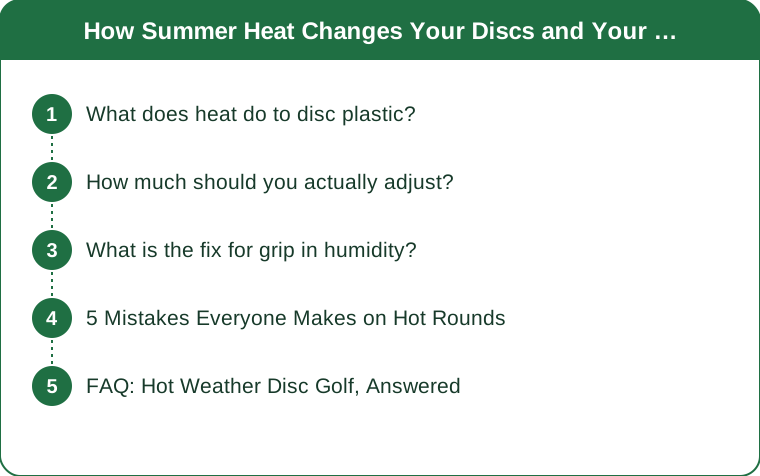
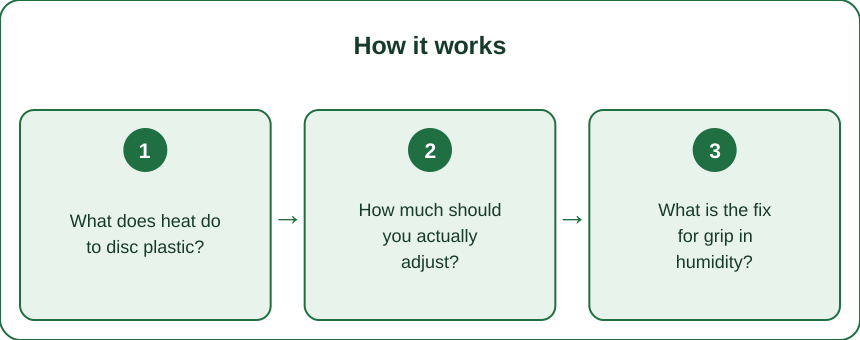
What does heat do to disc plastic?
Plastic is a thermoplastic material, which means its stiffness varies with temperature. In heat it becomes more pliable, and a more flexible disc deforms slightly more in flight.
The practical result is reduced stability. A disc that reliably held a straight line at 70F will turn more at 95F, and an already understable disc can flip and burn over entirely.
Premium plastics resist this more than baseline plastics, which is one reason base-plastic discs left in a hot car become dramatically more understable over a season.
The reverse happens in cold - discs stiffen and play more overstable, which is why winter rounds feel like everything fades early.
How much should you actually adjust?
A reasonable rule for a 90F-plus round: throw one stability step more overstable than usual.
If your standard fairway driver is a straight-to-slightly-understable mold, take the more stable option in the bag. If you normally throw a neutral midrange on a hole, expect it to turn and plan for it, or step up.
Also expect more distance. Hot air is less dense, which reduces drag - most players see modestly longer throws in heat, which combines with reduced stability to produce shots that go long and right for a right-hand backhand thrower.
That combination is why hot rounds produce unfamiliar over-the-green results on holes you know well.

What is the fix for grip in humidity?
Grip failure is the bigger scoring problem, and it is entirely solvable.
A dry towel, kept dry. One towel for hands, a separate one for wiping discs. Clip the hand towel where it stays in shade.
A chalk or grip bag. Inexpensive and it works, especially in humidity where a towel alone gets saturated within a few holes.
Rotate discs. A disc that has been in a sweaty hand does not fully dry between holes. Wipe it before it goes back in the bag.
Adjust the grip pressure, not the grip style. Players who lose a disc early on a hot day usually respond by squeezing harder, which changes the release timing and creates a whole new problem.
5 Mistakes Everyone Makes on Hot Rounds
Leaving discs in the car. Sustained heat in a trunk warps discs permanently, particularly base plastics. It is the single most common way people ruin a bag.
Blaming the throw for the flip. Two or three flipped drives in a row on a hot day is usually the plastic, not the form.
One water bottle for eighteen holes. A summer round is two to three hours of walking with a bag in the sun. Two liters minimum, with electrolytes.
No towel management. One soaked towel is worse than useless by hole six.
Playing peak afternoon. This is the third mistake and it costs the most - a morning or evening round is a different sport in August, and it is also when the course is least crowded.
FAQ: Hot Weather Disc Golf, Answered
Do discs really get more understable in heat?
Yes - warmer plastic is more flexible and turns more in flight. The effect is most pronounced in baseline plastics and least in premium blends.
Can heat permanently damage a disc?
It can. Sustained high temperature in a car trunk warps discs and changes flight characteristics permanently, and the warping is often invisible until you throw it.
How much water should I carry for eighteen holes?
At least two liters in hot weather, with electrolytes for rounds over two hours. Walking a wooded course in 90F is a real endurance activity even though it does not feel like one.
TL;DR:
- Warm plastic is more flexible, so discs turn more and play less stable than their numbers suggest.
- Throw one stability step higher on 90F-plus rounds, and expect extra distance from less dense air.
- Carry two towels and a chalk bag; grip failure costs more strokes than stability does.
- Never leave discs in a hot car - the warping is permanent.
Hot rounds are not a test of whether your form survived the summer. They are a different set of flight conditions, and adjusting the bag by one stability step handles most of it.
Keep Reading
This article is for general informational and styling purposes only. Fit, sizing, and product availability may vary.