Disc Golf in Early Fall: Leaves, Low Light, and the Discs You Will Lose
Quick Answer: Switch to high-visibility discs before the leaves come down, not after, and add a small light to your bag now rather than in October. Leaf cover makes a mid-flight disc easy to follow and nearly impossible to find on the ground, and dusk arrives 2 to 3 minutes earlier each day - so the last two holes are the ones that catch people out.
The cheap insurance nobody buys until they have lost a favorite disc: a name and phone number written on every disc.

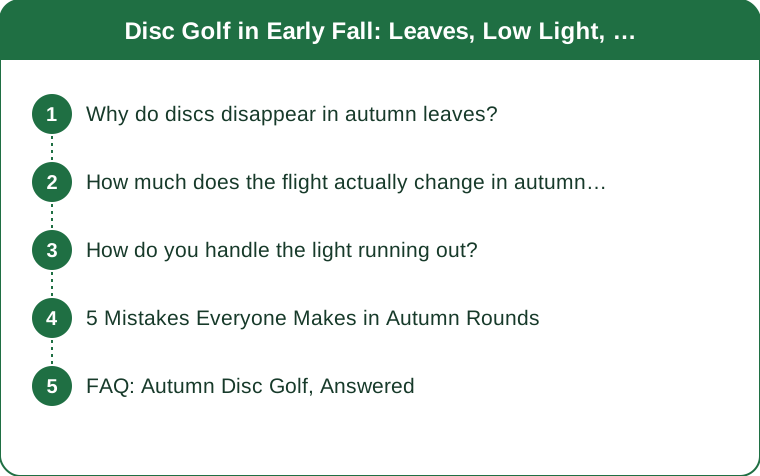
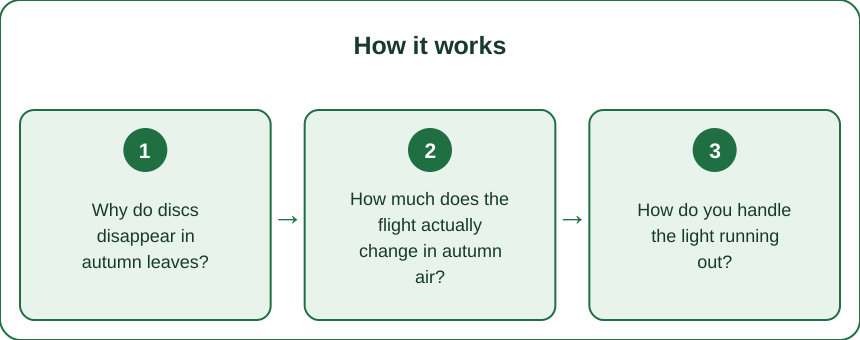
Why do discs disappear in autumn leaves?
Because leaf cover breaks the two things you use to find a disc.
Visual contrast disappears. The forest floor becomes a mottled field of yellows, oranges, browns and reds. A disc in any earth tone - tan, orange, red, brown, yellow, olive - becomes effectively camouflaged, and those are extremely common disc colors.
Depth cues disappear. A layer of leaves several inches deep swallows a disc completely. A disc that skips under the leaf layer is invisible from any angle, and it will not be found by looking - only by walking on it or raking.
The sound cue is gone too. In summer you often hear a disc land or hit a tree. Dry leaves absorb and mask that, and everything sounds like a disc landing.
Which colors survive leaf cover:
- Bright pink and magenta, which are the most reliable and appear nowhere in nature at this time of year
- Bright blue and purple, excellent contrast against warm-toned leaves
- White, good in leaves and poor in snow, which matters later in the season
- Bright green, good in leaves and poor in summer
Which colors to retire until spring: orange, yellow, red, tan, brown, olive, and any earth tone. They are all leaf colors, and this is the specific reason the annual autumn disc-loss spike happens.
The cheap insurance that most players skip: write your name and phone number on every disc with a permanent marker. The disc golf community has an unusually high return rate, and a marked disc that ends up in a lost-and-found or a lake retrieval bag frequently comes home. An unmarked one never does.
How much does the flight actually change in autumn air?
Meaningfully, and in a direction most players do not expect.
Cold air is denser. A disc flying through denser air experiences more lift and more drag. The practical result is that discs behave more overstable in cold air - they fade harder and finish left for a right-handed backhand thrower.
How much:
- The effect is noticeable below roughly 10C and pronounced below freezing
- In early autumn, at 12 to 18C, the change is small but real - typically a slightly earlier fade and a few metres of lost distance
- Understable discs that were flippy in August become more controllable, which many players enjoy
Plastic gets harder and less grippy in the cold. Premium plastics stiffen noticeably, and a stiffer disc:
- Is more overstable than the same disc warm
- Is more likely to chip or crack on a tree hit, particularly below freezing
- Feels different in the hand, which affects release more than most players account for
Practical adjustments for autumn:
- Carry one step more understable than your summer selection for the same shot shapes
- Keep discs inside your jacket or bag rather than exposed, so the plastic stays closer to room temperature
- Expect to lose some distance, roughly 5 to 10 percent as it gets genuinely cold, and stop trying to make it up by throwing harder
On grip, which matters more than flight in early autumn. Cool mornings with dew leave the disc and your hands damp. A small towel on the bag is the highest-value autumn accessory - a slipping grip at release does far more damage to a round than a few metres of density effect.
On wind. Autumn winds are typically stronger and gustier than summer. Combined with cold-air overstability, a headwind in October is much more punishing than the same wind in July.

How do you handle the light running out?
Plan the round backward from sunset, and carry a light before you need one.
The arithmetic. Daylight is currently shortening by roughly 2 to 3 minutes per day. That is 45 minutes over a fortnight - enough that the after-work round you played comfortably two weeks ago now finishes in the dark.
Planning the round:
- Check the sunset time, then subtract 30 minutes for usable light. Dusk under tree cover is much darker than dusk in the open
- Budget roughly 15 minutes per hole for a casual round with a group, less for a solo speed round
- Know your bail-out points. Which hole can you cut to the parking lot from? Deciding that at hole 12 in the dark is worse than deciding it in the car park
What to carry:
- A small headlamp or clip light, which weighs almost nothing and turns a failed search into a found disc. This is the single most useful item to add to an autumn bag
- A phone with charge, which is a poor light and an adequate one
- A brightly colored disc for the last holes specifically, if the rest of your bag is dark
On glow discs and night rounds. Autumn is when night disc golf starts, and it is genuinely enjoyable. Glow plastic needs charging with a UV light - phone flashlights do very little - and the etiquette is to check that the course permits after-dark play.
On safety in low light:
- Course wildlife is more active at dusk, which is worth knowing in areas with deer or other large animals
- Footing gets harder to read as light drops, and wet leaves over roots are a genuine ankle risk
- Tell someone your route if playing a wooded course solo at dusk, which costs nothing
5 Mistakes Everyone Makes in Autumn Rounds
1. Playing earth-tone discs into leaf cover. Orange, yellow, tan and red are all leaf colors right now. This one change prevents most autumn disc losses, and it costs nothing if you already own bright discs.
2. Not marking discs. Name and number in permanent marker takes 20 seconds. The disc golf community returns marked discs at a remarkable rate, and an unmarked disc is gone forever.
3. Throwing harder to make up cold-air distance. Denser air costs distance, and throwing harder costs form. Accept the shorter flight and take one more disc of speed instead - the round scores better.
4. Ignoring grip in dew. Cool morning rounds mean damp discs and damp hands, and a slipped release costs more strokes than any conditions effect. A towel is the fix and it lives in the bag permanently.
5. Starting a round too late. Sunset is 45 minutes earlier than it was two weeks ago, and it will be 45 minutes earlier again in another two. Check the actual sunset time rather than going by how it felt last month.
The pattern: autumn conditions change gradually enough to be invisible day to day, and enough over a fortnight to change how you should play.
FAQ: Autumn Disc Golf, Answered
What disc colors are easiest to find in leaves?
Bright pink, magenta, blue, purple and white. Retire orange, yellow, red, tan and olive until spring - they are all leaf colors.
Do discs really fly differently in cold weather?
Yes. Denser cold air makes discs behave more overstable, fading earlier and flying slightly shorter. Below about 10C the effect is noticeable.
Should I change my discs for autumn?
Carry one step more understable than your summer selection for the same shot shapes, and keep discs warm in your bag rather than exposed.
What is the most useful thing to add to my bag?
A small headlamp or clip light, and a towel. The light turns failed searches into found discs; the towel handles dew and damp grip.
How do I stop losing discs entirely?
Mark every disc with name and phone number, use bright colors, and watch the disc all the way to the ground rather than following your own throw’s arc.
Can I still play after dark?
Glow discs and a UV charging light make night rounds genuinely good, but check that your course permits after-dark play first.
TL;DR:
- Leaf cover camouflages earth-tone discs and swallows them entirely - switch to pink, blue, purple or white now
- Mark every disc with name and number; the return rate in this community is unusually high
- Cold, denser air makes discs fly more overstable and slightly shorter; carry one step more understable rather than throwing harder
- Dew and damp hands cost more strokes than any conditions effect - keep a towel in the bag
- Sunset moves 45 minutes earlier every fortnight; plan the round backward from it and carry a light
Autumn is the best disc golf weather of the year. It is also the season most discs are lost, and both facts have the same cause.
Keep Reading
This article is for general informational and styling purposes only. Fit, sizing, and product availability may vary.