A Home Putting Routine That Actually Lowers Your Disc Golf Scores
Quick Answer: Ten feet of clear space, four or five identical putters, and twenty minutes three times a week moves your make percentage more than any new driver ever will. The routine: warm up close, run a ladder drill from 10 to 30 feet where you only move back after three straight makes, add one pressure game with real stakes, and finish with a walk-back finisher. Track makes out of twenty once a week - the number climbing is the whole feedback loop. No basket? A laundry basket on a chair trains the same stroke.
Every disc golfer knows the feeling: a beautiful drive, a clean approach, and a missed 18-footer that turns a birdie story into a par nobody tells. Putting is where recreational rounds leak strokes - and it happens to be the one skill that fits in a backyard, a garage, or a basement hallway, no course required. The players who seem born with a putt mostly just own a home basket and a boring routine. Here is the boring routine.

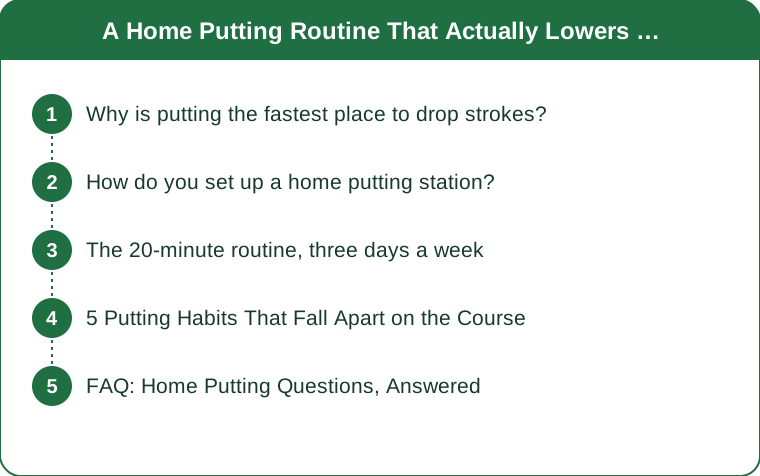
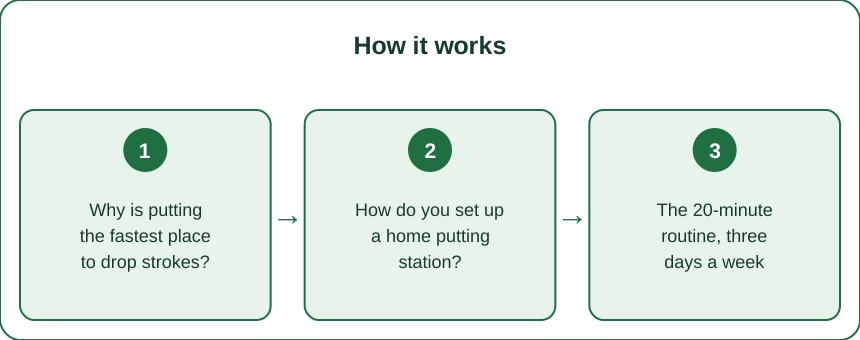
Why is putting the fastest place to drop strokes?
Run the honest audit on your last round and the argument makes itself.
Count the shots inside 33 feet. For most recreational players, putts and short approach shots account for a third or more of total strokes - a typical 60-throw round contains 18 to 25 shots from inside circle range. No other single skill touches that many strokes. A driver upgrade might affect a dozen throws a round; your putting stroke shows up on nearly every hole, twice on the bad ones.
Putting improvement transfers almost perfectly from practice to course. Driving involves wind, footing, shape decisions, and terrain that a field session only partially recreates. A putt is the same 15 feet of flat air everywhere - the stroke you groove at home is, mechanically, the exact stroke you use Sunday. Few sports offer a purer practice-to-performance pipeline.
It needs no athleticism budget. Distance gains demand fitness, flexibility, and months of form work. Putting rewards repetition and calm - which means it is the discipline where a busy adult with twenty spare minutes can genuinely out-practice better athletes. The player who putts 200 reps a week beats the player with the prettier drive on the scorecard, routinely.
And the compounding is psychological. Confidence from ten feet changes your approach game - suddenly landing anywhere in the circle feels like a made putt, so approaches relax, so more of them land close. Miss enough short ones and the reverse spiral starts: pressure on approaches, tension on drives, blow-up holes. A trustworthy putt is the keystone habit of the entire scorecard.
The audit to run once: after your next round, count strokes lost inside the circle - putts missed from inside 20 feet, three-putts, lay-ups from makeable range because you did not trust the stroke. That number is your cheapest available improvement, sitting in your own yard.
How do you set up a home putting station?
The station’s job is removing every excuse between you and daily reps. Total setup: one evening.
The basket question. A practice basket is the single best equipment purchase in disc golf - entry-level models cost less than two premium drivers and last a decade. Placement: anywhere with 25 to 30 feet of clear approach - backyard, garage with the car out, basement with ceiling clearance for the putt’s arc. If weather or space rules outdoors out, indoor works better than people expect: putting arcs are modest, and a hallway of 15 feet trains the stroke that matters most.
No basket? Improvise honestly. A laundry basket on a chair at chain height, a box taped to a wall at 32 inches center height, or a hula hoop hung from a door frame all train aim and release. You lose the chain feedback - the glorious sound - but the stroke does not know the difference. Many players start improvised, confirm the habit sticks, then buy the basket as the reward.
Distance markers make practice measurable. Tape lines, painter’s-tape squares, or yard objects at 10, 15, 20, 25, and 30 feet. Guessing distances is how practice goes vague; lines are how the ladder drill and your weekly tracking stay honest.
Four to six identical putters, same mold, same plastic. Practicing with one putter means walking after every throw - rep rate collapses and so does the habit. Practicing with a mixed bag of molds means every throw teaches a slightly different lesson. A stack of the same putter is the difference between 40 reps and 150 reps in the same twenty minutes.
Light and weather-proofing decide winter. An outdoor station that dies at dusk dies in October; a garage corner or a clamp light on the basket keeps the routine alive through the dark months. The station that survives the seasons is the one that changes your spring rating.

The 20-minute routine, three days a week
Structure beats volume. The same twenty minutes, in four blocks:
Block 1 - close-range warm-up, 3 minutes. Ten putts from 10 feet, focusing purely on clean release and a confident follow-through - chest to the chains, hand finishing where the putt went. You are rehearsing the feeling of certainty, which is a real and trainable thing, before distance enters the conversation.
Block 2 - the ladder, 8 minutes. Start at 10 feet. Make three in a row to earn the move back to 15, then 20, 25, 30. Miss once and you return one station forward. This single drill is most of the program: it concentrates your reps at the distances you actually face, punishes lazy strokes immediately, and turns every putt into one that matters - which is the exact skill the course tests.
Block 3 - the pressure game, 6 minutes. Pick one and rotate weekly: Streak (count consecutive makes from 15 feet; beat your record before time ends), Around the World (one make from five stations in a semicircle, restart on any miss), or Season Finale (five putts from 20 feet, and a stake you care about - the last one decides whether you get dessert, or whether the practice counts as complete). Manufactured pressure is imperfect, but it is the only rehearsal available for the real thing.
Block 4 - the walk-back finisher, 3 minutes. One putter only. Make from 10, walk back to 15; make, walk to 20; as far as you get in three minutes, one throw per station like the course gives you. Retrieving after every putt slows the body and focuses the mind - ending here bridges practice rhythm to round rhythm.
The tracking habit that makes it real: once a week, first thing in a session, throw twenty putts from 20 feet and write the number down. No warm-up adjustment, no do-overs. That cold number is your rating - watching it climb from 8 to 13 over two months is the most motivating chart in your phone.
5 Putting Habits That Fall Apart on the Course
1. Practicing only from your comfort distance. The 15-foot groove feels productive and leaves you helpless from 25. The ladder exists to force the uncomfortable stations - if your practice session never contains a miss, it never contained the course either.
2. Practicing only on flat, calm evenings. The course serves up wind, slopes, and putts from awkward stances. Once a week, put reps on a slight slope, putt from a knee, or practice in the breeze you would normally wait out. A stroke that only works in laboratory conditions is a laboratory stroke.
3. Rushing the routine when someone is watching. Solo practice builds a pre-putt routine - stance, breath, target focus, throw - and casual rounds with friends dissolve it in about three holes. The routine is not a ritual for show; it is the delivery mechanism for the practiced stroke. Same four beats, every putt, especially with an audience.
4. Only ever putting fresh. Course putts happen on tired legs, late in rounds, after climbing a hill. Ending a workout or a long walk with ten minutes of putts trains the skill in the body state that actually misses them - the round is lost on the back nine legs, not the front nine stroke.
5. Never practicing the comebacker. The putt after the missed putt - 8 feet of pure annoyance - is where bogeys become doubles. Build it in: every ladder miss, play the disc where it lies and make the cleanup before resuming. Practicing the recovery removes the fear of the miss, and removing the fear of the miss is, circularly and wonderfully, what makes you miss less.
FAQ: Home Putting Questions, Answered
Should beginners learn spin putting or push putting?
Start with a push-spin hybrid biased toward push: a pendulum motion from the legs with modest spin is more repeatable inside 20 feet, holds lines in calm conditions, and builds touch. Pure spin putts earn their place at longer range and in wind - most accomplished putters blend styles by distance, and your home station is exactly where that blend gets discovered.
How many putts per practice session?
The 20-minute routine lands between 80 and 150 reps depending on retrieval pace, which is plenty. Quality collapses past the point of boredom or fatigue - three focused 20-minute sessions a week beat one heroic two-hour Saturday, both for skill retention and for the habit surviving the school-year schedule.
Do I need expensive putters for practice?
No - you need identical ones. Four or five of the same mold in base plastic costs less than one premium driver and matters infinitely more. Base plastics also grip more consistently in cold and damp, which your fall and winter sessions will appreciate.
How long until home practice shows up on the scorecard?
Most players see the weekly tracking number move within three to four weeks, and course results follow a round or two behind - the lag is confidence catching up to competence. The visible milestone: the day an 18-footer on the course feels like a formality instead of a question. That day is closer than it sounds.
TL;DR:
- A third of your strokes happen inside the circle - putting is the cheapest scorecard improvement available.
- Station: basket or laundry-basket stand-in, taped distance markers, four identical putters, light for the dark months.
- The routine: close warm-up, ladder drill, one pressure game, walk-back finisher - twenty minutes, three days a week.
- Track twenty cold putts from 20 feet weekly; the climbing number is the whole motivation system.
- Practice the wind, the slope, the tired legs, and the comebacker - the course tests those, not the flat calm evening.
Nobody admires a putting routine the way they admire a 350-foot drive. But the scorecard cannot tell the difference between talent and repetition - and repetition is on sale in your backyard, twenty minutes at a time.
Keep Reading
This article is for general informational and styling purposes only. Fit, sizing, and product availability may vary.