Why Carrying Fewer Discs Usually Lowers Your Score
Quick Answer: Carrying five to eight discs beats carrying twenty for most recreational players because repetition builds a reliable feel for each disc, and choice under uncertainty produces hesitation. A smaller bag means more throws per disc per round, faster and more confident decisions, less weight on your shoulder over eighteen holes, and a genuine understanding of what each disc does when you throw it rather than what the flight numbers claim. Build the small bag around one putter, one midrange, one fairway driver, and one distance driver, then add a stable and understable option only if you actually need them.
You bought the twenty-disc bag because you kept encountering shots you did not have a disc for.
The shots were never the problem. Not knowing what any given disc would do was.

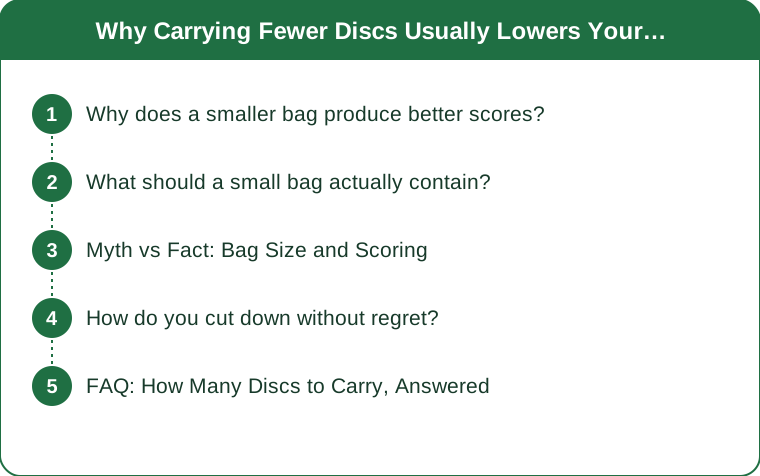
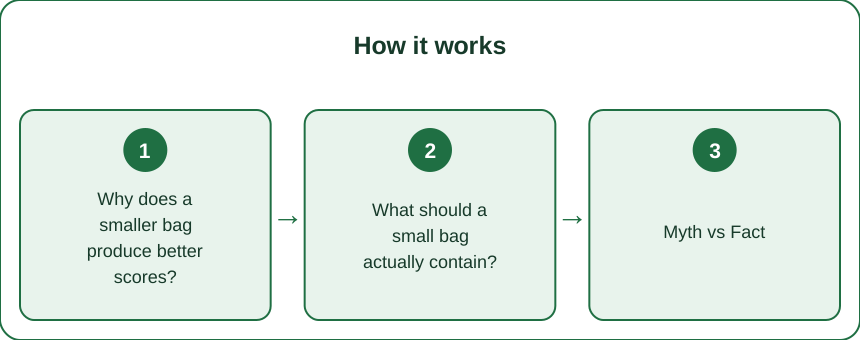
Why does a smaller bag produce better scores?
Repetition is what makes a disc predictable. If you throw a round of eighteen holes with six discs, each one gets thrown several times. With twenty discs, some get thrown once and several not at all, and a disc you throw once a round is one you are guessing with.
Choice creates hesitation. Standing on a tee comparing four similar drivers costs time and, more importantly, confidence. A decision made quickly and committed to produces a better throw than a carefully optimised choice thrown tentatively.
You learn shot shaping instead of disc shopping. With a small bag, reaching a particular line means adjusting angle, power, and release rather than finding a disc that does it for you. Those adjustments transfer to every disc you will ever throw.
Weight matters over a full round. Twenty discs plus water is a meaningful load to carry for two hours, and fatigue in the shoulder and back shows up in form on the back nine.
Consistency compounds. Knowing precisely what your midrange does at 70 percent power is worth more than owning three midranges you know approximately.
And most bags contain duplicates in disguise. Two discs with similar flight characteristics in different plastics feel different but do broadly the same job, which multiplies decisions without adding capability.
What should a small bag actually contain?
One putter you use for everything close. Putting, short approaches, and tight tunnel shots. Many strong players carry two of the same putter in different wear states, which is a duplicate that genuinely earns its place.
One midrange. This becomes the most thrown disc in your bag after the putter and is where most of your scoring happens - approaches, controlled tee shots on short holes, and anything under about seventy metres.
One fairway driver. Controllable distance for tighter lines. For a lot of recreational players this outperforms a distance driver on the majority of holes.
One distance driver. Only if you have the arm speed to make it fly as designed. Thrown too slowly, a high-speed driver simply fades early and goes shorter than a fairway driver would.
Then, optionally, one understable and one overstable disc. These handle the shaped shots - a turnover line and a reliable fade or a headwind. Add them once you can predict what your core four do.
That is four to six discs, plus a spare putter. Somewhere between five and eight total. For most recreational players this covers every shot they can currently execute.

Myth vs Fact: Bag Size and Scoring
Myth: More discs mean more options. Fact: they mean more decisions. Options you cannot execute reliably are not options, they are hesitation.
Myth: Pros carry twenty discs, so you should. Fact: professionals throw thousands of practice shots and genuinely know each disc’s behaviour at multiple power levels. The bag reflects that knowledge; it does not create it.
Myth: You need a disc for every situation. Fact: you need a small set you can shape. Angle, power, and release point cover far more ground than most players use.
Myth: Flight numbers tell you what a disc will do. Fact: they describe behaviour at a specified arm speed with a clean release. What matters is what it does when you throw it, which you can only learn by throwing it repeatedly.
Myth: A beaten disc should be replaced immediately. Fact: a worn disc that has become more understable is often the most useful disc in a bag, and it is one you already know intimately.
Myth: Cutting down means giving up distance. Fact: most recreational players gain distance from a controllable fairway driver thrown well over a high-speed driver thrown at insufficient speed.
How do you cut down without regret?
Play three rounds with a deliberately small bag. Six discs, no exceptions. Note every shot where you genuinely wished you had something else, and note what the shot actually required.
Look at the notes rather than your instincts. Most players find one or two genuine gaps rather than the eight they expected, and the gaps are usually a shaped shot rather than a distance one.
Keep the discs you throw well, not the ones you like. There is almost always a disc you enjoy owning and throw badly. It is the first one to leave the bag.
Keep the extra discs at home rather than selling them. Removing the pressure of a permanent decision makes the experiment much easier to run.
Add back one disc at a time. If the notes say you need a headwind disc, add one overstable driver and play three more rounds. Adding one at a time keeps the bag honest.
And check your score, not your feeling. The small bag will feel underprepared for the first round or two. Compare the actual scores across three rounds before deciding it did not work.
FAQ: How Many Discs to Carry, Answered
How many discs should a beginner carry?
Five to eight is plenty: one putter, one midrange, one fairway driver, and optionally a distance driver plus one understable and one overstable option. More than that dilutes the repetitions you need to learn each disc.
Will carrying fewer discs cost me distance?
Usually the opposite. A controllable fairway driver thrown well typically travels further than a high-speed distance driver thrown below the arm speed it was designed for.
What is the most important disc in the bag?
The putter, by a wide margin - it handles putting, short approaches, and tight lines, and it gets thrown more than anything else in a round.
Should I carry two of the same disc?
Two putters in different wear states is a genuinely useful duplicate. Two similar drivers in different plastics mostly adds a decision rather than a capability.
TL;DR:
- Five to eight discs beats twenty for most recreational players because repetition is what makes a disc predictable.
- More discs mean more decisions and more hesitation, and hesitation costs more strokes than an imperfect disc choice does.
- Build around one putter, one midrange, one fairway driver, and a distance driver only if your arm speed supports it.
- Learn shot shaping - angle, power, release - instead of buying a disc for every line.
- Test it over three rounds, note the genuine gaps, and add back one disc at a time based on notes rather than instinct.
The bag is not what is missing. The repetitions are.
Keep Reading
This article is for general informational and styling purposes only. Fit, sizing, and product availability may vary.