Is Your Disc Golf Elbow Pain a Technique Problem or Just Overuse?
Quick Answer: Disc golf elbow pain usually comes from one of two overlapping causes — pure overuse from high throwing volume without adequate recovery, or a specific technique flaw (commonly relying too much on wrist and forearm snap instead of full-body rotation) that overloads the elbow tendons on every single throw — the distinction matters because overuse responds mainly to rest and volume management, while a technique flaw will keep causing pain again even after rest if the mechanics aren’t corrected.
Telling the two apart usually comes down to whether the pain shows up specifically during high-volume stretches or consistently even at low throwing volume, which points toward the more mechanical explanation.

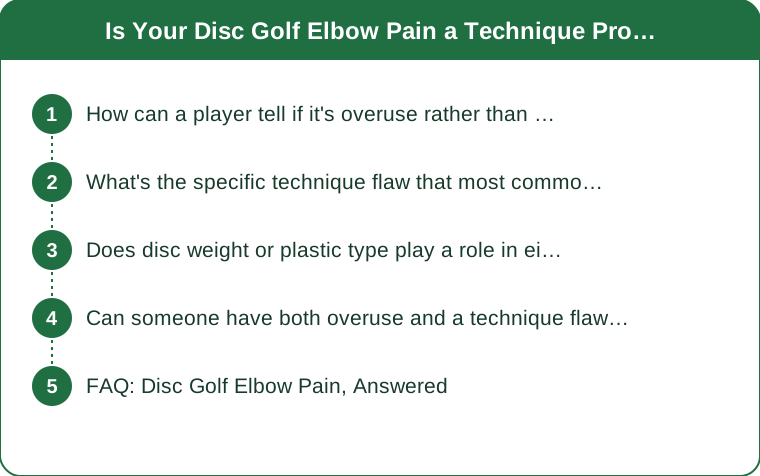
How can a player tell if it’s overuse rather than a technique issue?
If elbow pain reliably shows up only after unusually high-volume rounds or practice sessions and improves clearly with a few rest days, that pattern points toward overuse rather than a fundamentally flawed throwing motion, since a genuine technique flaw tends to cause pain even at normal, previously-tolerated throwing volumes.
What’s the specific technique flaw that most commonly causes this kind of pain?
Relying primarily on wrist-snap and forearm rotation to generate power, rather than driving power from hip rotation and the full kinetic chain through the torso, concentrates repetitive stress directly on the elbow tendons with every throw, which is a mechanical overload pattern rather than simply a volume problem.

Does disc weight or plastic type play a role in either cause?
Heavier discs or higher-speed drivers require more force per throw, which can accelerate both overuse fatigue and the impact of a technique flaw, so equipment choice can make an existing problem worse faster, though it’s rarely the sole cause on its own.
Can someone have both overuse and a technique flaw at the same time?
Yes, and this combination is actually quite common — a technique flaw creates baseline elevated stress on the elbow with every throw, and then a high-volume day or tournament weekend pushes that baseline stress past the threshold where symptoms appear, which is why addressing only one factor (just resting, without fixing technique) often leads to recurring pain once throwing volume increases again.
FAQ: Disc Golf Elbow Pain, Answered
Is it worth getting throwing form reviewed by a coach or experienced player if pain persists?
Yes, a form review from someone experienced with proper power generation mechanics is one of the most direct ways to identify whether a technique flaw is contributing to elbow strain.
How much rest is typically needed for overuse-related elbow pain to resolve?
Mild cases often improve within a week or two of reduced throwing volume, while more significant cases can take several weeks and may benefit from a physical therapist’s guidance.
Does strengthening the forearm help prevent this kind of injury?
Forearm and grip strengthening can help with overall resilience, but it doesn’t substitute for correcting a genuine power-generation technique flaw if one is present.
TL;DR:
- Disc golf elbow pain generally traces to overuse, a technique flaw, or both together
- Pain that appears only during high-volume stretches points more toward overuse
- Pain at normal throwing volumes often points to a wrist-reliant technique flaw
- Heavier discs and higher speeds can accelerate either underlying cause
Rest alone resolves overuse-driven pain, but a technique flaw needs an actual mechanics fix, or the same pain tends to come back once throwing volume picks back up.
Keep Reading
This article is for general informational and styling purposes only. Fit, sizing, and product availability may vary.