Disc Selection for Beginners: Why You Don't Need 20 Discs to Start
Quick Answer: Start disc golf with just three discs: a putter, a midrange, and one slow, understable fairway driver (speed 6–8). Skip the high-speed distance drivers entirely — they need arm speeds most beginners don’t have yet and will just dump left. Three discs costs about $30–45 and will lower your score faster than a full bag of twenty.
The pro shop wall has three hundred discs on it. They’re color-coded, numbered, and organized by a system nobody explains. You came to throw a frisbee at a basket.
Here’s the good news: you need almost none of it. And the players who start with three discs get better faster than the ones who start with twenty. That’s not folk wisdom — it’s a consequence of how the sport actually works.

What Are the Three Types of Disc Golf Discs?
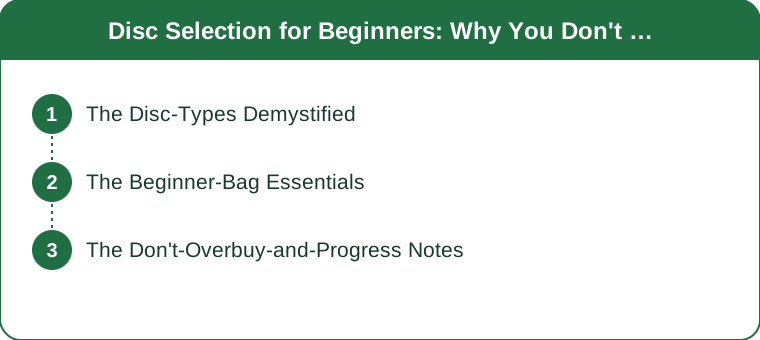
Putters. Blunt, rounded edge. Slow, stable, and predictable. Used for putting and short approach shots — and, for beginners, a surprising number of drives.
Midranges. Slightly sharper edge, a bit more speed. The accuracy workhorse. Most shots between 150 and 250 feet belong to a midrange.
Drivers. Sharp, thin edge built to cut through air. Split into fairway drivers (moderate speed, controllable) and distance drivers (high speed, unforgiving). The wall is mostly these, and they are mostly not for you yet.
What Do the Numbers on a Disc Mean?
Every disc has four numbers printed on it — the flight ratings:
- Speed (1–14): how much arm speed the disc needs to fly as designed. Not how fast it goes.
- Glide (1–7): how well it stays aloft. Higher glide = more distance for less power.
- Turn (+1 to −5): how much it curves right early in flight (for a right-hand backhand throw). More negative = more understable = easier for beginners.
- Fade (0–5): how hard it hooks left at the end. Lower fade = straighter finish.
A disc marked 7 / 5 / −2 / 1 is a moderate-speed, high-glide, understable fairway driver — close to a perfect beginner disc. A disc marked 13 / 5 / −1 / 3 is a distance driver that will fly beautifully for someone throwing 400 feet and will nosedive left for you.
Speed is the number that matters most right now. Stay at 8 or below.

What Discs Should a Beginner Buy?
Three. Total. Roughly $10–15 each in base plastic.
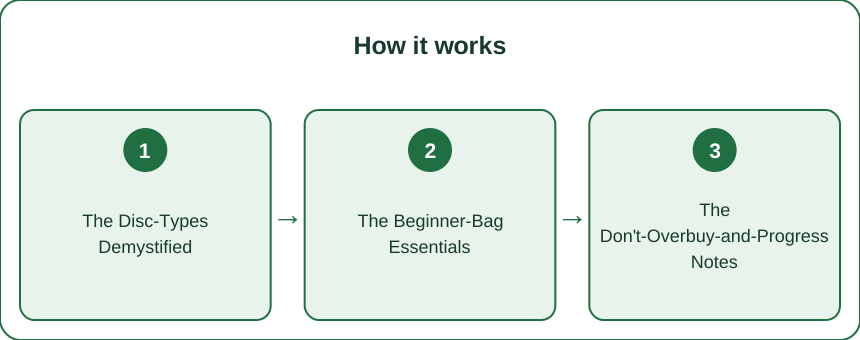
1. A putter (speed 2–3). Buy two of the same model if you can — you’ll want a matched pair for practice putting at home. This is the disc you’ll throw most in a round, and it’s the one that lowers scores fastest. Good beginner-friendly options are widely available from every major manufacturer.
2. A midrange (speed 4–5, turn 0 to −1). Your accuracy disc. For the first month or two, most of your shots should be this disc. It flies straight, it’s forgiving, and it teaches you what a clean release feels like.
3. One understable fairway driver (speed 6–8, turn −2 to −3). Notice: fairway, not distance. Understable, not stable. This disc will actually fly straight or gently right for your current arm speed instead of hooking hard left the moment it leaves your hand.
That’s the bag. You can carry it in a shoulder bag or honestly just in your hands.
Why Do Fast Discs Fly Worse for Beginners?
This is the single most counterintuitive thing in the sport, and it’s why the wall of plastic is a trap.
A high-speed distance driver is aerodynamically designed to be stabilized by air speed. Throw it at 60 mph — a typical beginner arm — and it never reaches the speed where its flight profile makes sense. It stalls, the fade takes over immediately, and it hooks hard left and lands 180 feet away.
Throw a speed-7 understable driver with that same 60 mph arm and it flies the way it was designed to: straight, with a gentle finish, and often 40–60 feet farther.
So the beginner buys the speed-13 driver because it says “maximum distance” on the packaging, gets 180 feet, and concludes they’re bad at disc golf. They’re not. They bought a disc built for a different arm.
5 Mistakes Everyone Makes Buying Discs
- Buying the fastest disc available. Covered above. Speed 8 and under until you’re consistently throwing 300+ feet.
- Buying premium plastic first. Base plastic ($10–13) is cheaper, grips better in the hand, and — genuinely useful — wears in faster, becoming more understable over time. Save the $20 premium plastic for when you know what you want.
- Buying heavy. Lighter discs (150–165g) are easier to get up to speed. Max weight (172–175g) is standard for experienced players and works against you early.
- Buying twenty discs. Every disc you add is one you throw less often. Consistency comes from knowing exactly how one disc flies out of your hand — and that takes hundreds of throws, not a bigger bag. The player with three discs they know beats the player with twenty they don’t. Every time.
- Buying before borrowing. Disc golf has one of the friendliest communities in sport. Show up at a course, mention you’re new, and someone will hand you three discs to try. Most players have a box of spares in the trunk. Try before you spend.
When Should You Add More Discs?
When your game asks for it — not before.
Concrete triggers worth waiting for:
- You’re consistently throwing 300+ feet with your fairway driver. Now a speed 9–10 driver makes sense.
- You keep facing a shot you can’t shape. If a course has a hole that demands a hard right-to-left finish and nothing in your bag does it, that’s a real reason to buy an overstable disc.
- You’ve worn one out. Discs get more understable with tree hits and age. Replacing a beat-in favorite is legitimate.
The natural progression is roughly: three discs for the first few months, five or six by six months, and a real bag of 8–12 once you know your throw. Players who follow that path almost always shoot better than those who bought the starter-set-of-twenty on day one.
And honestly — form beats gear here by a wide margin. Ten minutes of putting practice in your yard will do more for your score than any disc purchase. Field work with one midrange will do more for your drives than a new driver.
Mini FAQ
How many discs do you need to start disc golf?
Three: a putter, a midrange, and a slow understable fairway driver. Many players carry only a putter and a midrange for their first few rounds and score better for it. Starter sets sold as three-packs are usually well-chosen and cost around $25–35.
What weight disc should a beginner throw?
150–165 grams for most beginners. Lighter discs require less arm speed to reach their intended flight and are more forgiving of an imperfect release. You can move up to 170g+ once your throw is consistent.
Is disc golf expensive to start?
It’s one of the cheapest sports to enter. Three discs run $30–45, and the vast majority of courses in the US are free to play. A bag is optional at first — most people start by carrying their discs.
TL;DR
- Three discs to start: putter, midrange, one understable fairway driver.
- Speed 8 or below. High-speed distance drivers need arm speed you don’t have yet and will fly shorter.
- Understable (turn −2 or −3) is your friend — it flies straight at beginner arm speeds.
- Light plastic, base plastic. 150–165g, $10–15 per disc.
- Borrow before you buy. The community will hand you discs to try.
- Master a few before adding more. Consistency comes from knowing your discs, not owning many.
Three discs, one afternoon, and you’ll outscore the guy with the twenty-disc backpack.
Keep Reading
This article is for general informational and styling purposes only. Fit, sizing, and product availability may vary.