Your Disc Golf Bag Is Heavier Than You Think and Your Shoulder Knows
Quick Answer: A loaded disc golf bag commonly weighs 7 to 14 kilograms once discs, water, and accessories are included, carried on one shoulder for two hours over uneven ground. That combination - asymmetric load, long duration, and rotational throwing on the same body - is why shoulder and lower back complaints are common. The fixes are a backpack-style bag with a hip belt, culling the disc count, and carrying on the non-throwing side if you use a single strap.
Nobody starts disc golf thinking about load carriage. Then you are two years in with twenty-two discs, a folding stool, two litres of water, and a shoulder that aches on the drive home.

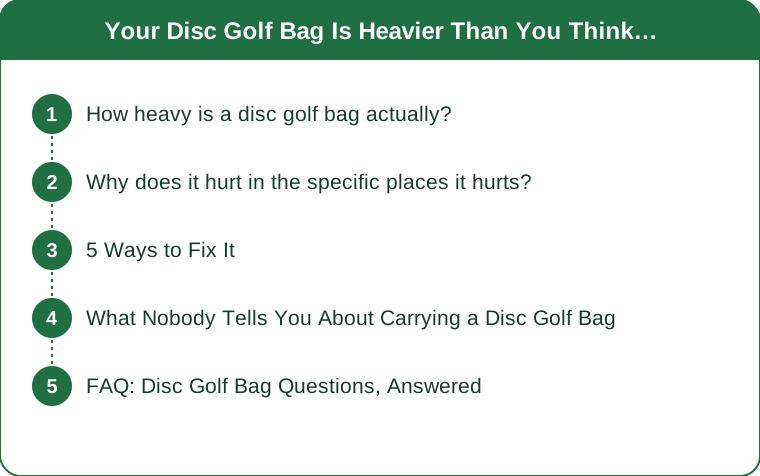
How heavy is a disc golf bag actually?
Heavier than most players estimate, and it creeps.
Discs weigh roughly 150 to 180 grams each. Twenty discs is therefore around 3 to 3.6 kilograms of plastic alone. A player carrying thirty - not unusual - is at 4.5 to 5.4 kilograms before anything else goes in.
Then the accessories:
- Water: 2 litres is 2 kilograms.
- The bag itself: 1 to 2.5 kilograms empty for a backpack-style bag, more with a built-in stool.
- Towel, mini marker, scorecard, snacks, phone, keys, first aid, bug spray, rain layer: another 1 to 2 kilograms.
A realistic total is 8 to 12 kilograms, and cart-free players carrying a full backpack bag on a long summer round with extra water can exceed that comfortably.
For context, common guidance for load carriage suggests keeping a carried pack under roughly 10 to 15 percent of body weight for sustained walking. For a 65-kilogram player, 10 kilograms is over 15 percent - carried for two hours, over uneven terrain, while performing repeated high-velocity rotational movements.
And the creep is the real issue. Nobody buys twenty discs at once. They accumulate one at a time, each addition weighing 165 grams, none of which feels like anything - which is exactly how the bag ends up at twelve kilograms without a single deliberate decision. The weight is never chosen, it is arrived at.
Why does it hurt in the specific places it hurts?
The pattern is consistent and it maps onto the mechanics precisely.
Top of the shoulder and side of the neck, carrying side. A single-strap bag loads the upper trapezius and levator scapulae continuously. These muscles are postural stabilisers, not load bearers, and holding a strap in place for two hours is exactly the kind of sustained low-level contraction they respond badly to.
Lower back, usually one-sided. An asymmetric load makes the trunk lean away from it to keep the centre of mass over the feet. The muscles on the opposite side of the lower back hold that lean for the whole round. This is the most common complaint among single-strap players.
Throwing shoulder, worse when it is also the carrying shoulder. Carrying loads the shoulder girdle statically; throwing loads it dynamically at high velocity. Doing both on the same side for two hours is a compounding load, and it is the most avoidable error in the whole activity - if you carry on one shoulder, carry on the non-throwing side.
Hips and knees on uneven ground. Added weight increases joint loading on descents in particular, where forces are highest. Wooded courses with steep sections amplify this considerably.
And fatigue changes your throw. By the back nine, a tired shoulder and trunk produce a different throwing motion - lower arm speed, more compensation, worse mechanics. So the bag is not just uncomfortable, it is measurably affecting the round. This is general information, not medical advice.

5 Ways to Fix It
1. Switch to a backpack bag with a real hip belt. Two straps distribute the load symmetrically and a hip belt transfers a substantial portion of the weight to the pelvis - the same principle that makes hiking packs tolerable. This is by far the biggest single improvement available, and it is the reason backpack bags took over the sport.
2. Cull the discs honestly. Most players use eight to twelve discs in a round and carry twice that. Keep a note for three rounds of which discs you actually throw. The unused ones weigh the same as the used ones. Dropping from 24 to 14 discs removes about 1.6 kilograms permanently.
3. Carry water smarter. Two litres is two kilograms and it is often the heaviest single item. If the course has a water source, carry one litre and refill. If not, at least start with the bottle in the main compartment close to your back rather than in an outer side pocket, where the offset weight increases the lever arm on your spine.
4. If you use a single strap, carry on the non-throwing shoulder, and switch sides regularly. This costs nothing and directly addresses the compounding-load problem. It feels awkward for two rounds.
5. Consider a cart for long or hilly courses. Disc golf carts have become common for good reason - they remove the carriage problem entirely on courses where the terrain allows. The players most resistant to carts are frequently the ones with the longest-standing shoulder complaints, which is worth sitting with.
What Nobody Tells You About Carrying a Disc Golf Bag
Strap width matters more than padding thickness. A wide strap spreads pressure over more surface area, which reduces peak pressure at the point where the strap meets the trapezius. A narrow, heavily padded strap still concentrates force in a narrow band. Width first, then padding.
Sternum straps do real work on single and double strap bags. They prevent the straps sliding outward off the shoulders, which is what forces you to shrug slightly to keep them in place. That constant micro-shrug is a genuine contributor to end-of-round shoulder fatigue.
Load position matters as much as load weight. Weight carried high and close to the back is far easier to carry than the same weight low and away from the body. Pack heavy items - water, extra discs - against your back and high in the bag, not in outer pockets.
Warming up the shoulder before the first drive is more important with a heavy bag, because you have already loaded the shoulder girdle statically on the walk from the car. Ten arm circles, ten band pull-aparts, and a few gentle practice throws take two minutes.
And the strength side is genuinely worth ten minutes twice a week. Rows, face pulls, and carries build the mid-back and shoulder stability that both carrying and throwing demand. The players who never get shoulder trouble are usually the ones doing some form of pulling work, not the ones with the lightest bags.
FAQ: Disc Golf Bag Questions, Answered
How many discs should I actually carry?
Most players use eight to twelve in a round. Tracking which discs you throw over three rounds usually reveals a third of the bag is dead weight. Competitive players carry more for specific shot shapes; casual rounds rarely justify more than about fifteen.
Are backpack disc golf bags better for your back?
Yes. Two straps distribute the load symmetrically and a hip belt transfers a meaningful share of the weight to the pelvis rather than the shoulders. Single-strap bags concentrate load on one side for the whole round, which is where most complaints originate.
Which shoulder should I carry a disc golf bag on?
The non-throwing shoulder, if you are using a single strap, and switch sides periodically. Carrying and throwing on the same side compounds static and dynamic load on the same structures across a two-hour round.
Why does my back hurt after a round of disc golf?
Usually a combination of an asymmetric carried load causing a sustained lateral lean, and repeated rotational throwing. A backpack bag with a hip belt addresses the first; a proper warm-up and some pulling strength work address the second. This is general information, not medical advice.
TL;DR:
- A loaded bag is commonly 8 to 12 kilograms, frequently over 15 percent of body weight.
- The weight is never chosen - it accumulates one 165-gram disc at a time.
- Backpack bag with a hip belt is the single biggest improvement available.
- If you use one strap, use the non-throwing shoulder and switch regularly.
- Most players carry roughly twice the discs they throw.
Nobody quits disc golf because of their bag. They just quietly stop enjoying the back nine, which is a slower version of the same thing.
Keep Reading
This article is for general informational and styling purposes only. Fit, sizing, and product availability may vary.