Backhand or Forehand: How to Actually Decide Which Disc Golf Throw to Learn First
Quick Answer: Most disc golf coaches recommend learning backhand first since it generates more natural power for beginners and is the throw most driving ranges and lesson content default to, but if you have a background in throwing sports like baseball or football, forehand can come more naturally and is worth prioritizing instead.
Trying to learn both throws with equal focus as a total beginner usually means neither develops real consistency — picking one to prioritize first gets you playable distance and accuracy faster.

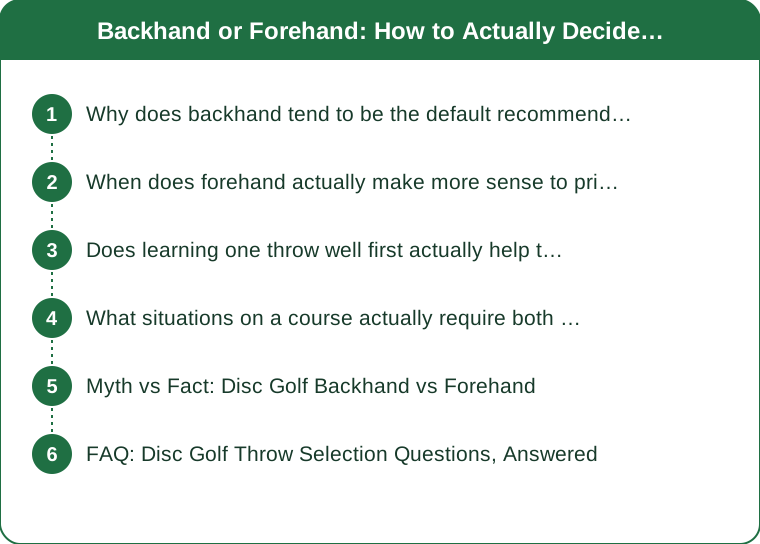
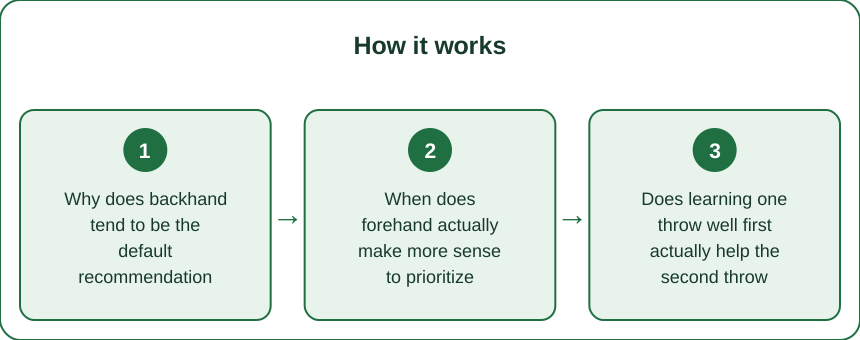
Why does backhand tend to be the default recommendation for beginners?
Backhand uses a rotational, full-body wind-up that most beginners can generate real power with even before their technique is refined, and the majority of beginner lesson content, YouTube tutorials, and driving range instruction defaults to backhand first, which means there’s simply more learning material built around it.
When does forehand actually make more sense to prioritize first instead?
If you have background in a throwing sport that uses a sidearm or overhand motion — baseball, football, javelin — the forehand throw’s mechanics tend to feel more immediately intuitive, since it borrows from movement patterns your body already knows, which can mean faster early progress than starting from scratch with backhand.
Does learning one throw well first actually help the second throw later?
Yes, meaningfully — once one throw has solid, repeatable mechanics, the general disc golf fundamentals (grip pressure, release timing, weight transfer) transfer conceptually to learning the second throw, even though the specific motion is different, making the second throw faster to pick up than starting cold.

What situations on a course actually require both throws eventually?
Certain hole shapes and obstacles favor one throw’s natural curve over the other — a hole that doglegs one direction often plays better with the throw whose natural curve matches that direction, which is why intermediate and advanced players eventually need both, just not necessarily on day one.
Myth vs Fact: Disc Golf Backhand vs Forehand
Myth: You need to learn both throws equally from the very start to progress properly. Fact: prioritizing one first, then adding the second once it’s consistent, tends to build usable skill faster than splitting focus evenly from day one.
Myth: Forehand is always the harder throw to learn. Fact: for players with a throwing-sport background, forehand can actually come more naturally than backhand.
Myth: The throw you learn first has to become your dominant throw forever. Fact: many experienced players end up relying more heavily on whichever throw they added second, once both are developed.
FAQ: Disc Golf Throw Selection Questions, Answered
How long does it typically take to get a first throw reasonably consistent?
With regular practice, most beginners see meaningfully more consistent contact and direction within 4-6 weeks of focused practice on a single throw, though full control takes longer.
Should discs be different for backhand versus forehand?
Some disc golfers do prefer slightly different disc stability ratings for each throw, but a beginner can start learning either throw with the same beginner-friendly driver before worrying about throw-specific disc selection.
Is it a problem to only ever really master one throw?
Not for casual or recreational play — plenty of players comfortably rely on one dominant throw for most holes, adding the second only becomes more important at a competitive level where hole variety demands more shot options.
TL;DR:
- Backhand is the common default recommendation due to natural power generation and available lesson content
- A throwing-sports background can make forehand the more intuitive first choice instead
- Getting one throw consistent first speeds up learning the second throw later
- Course variety eventually rewards having both, but that’s not a day-one requirement
Pick one throw based on your own background, spend a few weeks building real consistency, then add the second — don’t try to split focus evenly from the start.
Keep Reading
This article is for general informational and styling purposes only. Fit, sizing, and product availability may vary.